Why Meeting Ryan Holiday Was an Experience I Will Never Forget
In May 2014, I flew the nest. Courtney and I found a one-bedroom apartment in the college town of Tempe, Arizona. Rent was $758 per month. Before signing the lease, I called my mom and asked her if she thought I could afford the $379 per month, my half of the rent.
“Well, honey, you have to calculate your monthly expenses. Can you afford it?”
I thought about it. “I don’t know? I think so?”
The day after we moved in, I figured I should get a job. Courtney would appreciate that. The store where I’d been slinging wine and liquor was now an hour’s drive away, so I needed a closer gig.
Around that time, Courtney’s friend from grad school visited. I took it upon myself to show him around his first day here, as Courtney had to work. “Don’t forget, you have to get a job today,” she said as I got in my car. “Oh yeah, thanks for the reminder!”
I wasn’t being sarcastic.
As her friend and I drove around, I looked for jobs. I had experience waitressing, so I stopped in the first sports bar I saw and asked if they were hiring. They were. I could start tomorrow. Sweet. Done with my to-do list for the day!
We drove around some more, and Courtney called. “You won’t believe it,” I told her. “We’re driving by this playground and there’s a rope structure thing that’s, like, three stories high. And kids are climbing to the top. You’d think their parents would be around…”
“I thought you were getting a job today.”
“Oh! I already got one!”
I was proud of myself. Getting a job could have taken an entire week. And I did it in one day. Before noon!
Fast-forward a few months.
I had become more serious. Responsibility will do that to you. I had a 9 to 5 now. Office job. Sales. The work was stressful and the hours long. But the money was good. If I kept my foot on the gas and kept working harder and faster, I could make more money and buy lots of nice things.
Throughout the next few years, making more money was my only goal. But no matter how much I made or how much I “accomplished,” I was still empty. Was life really just a continuous sprint to acquire bigger commission checks and bigger houses? To go on fancier vacations? That is what I’m spending the majority of my waking hours pursuing? It didn’t make sense to me, but what else was there to aim for? Life started to feel like a sick joke.
One day in 2016, on my way home from work, drained from another day of trying to decipher the meaning of life between an onslaught of phone calls, I was listening to an interview Tim Ferris had with Ryan Holiday, and he said something that shook me.
Ryan was talking about Marcus Aurelius and how, as emperor of Rome 2,000 years ago, he had been the most powerful man in the world. He could have anything and do anything he wanted. And yet, unlike almost every example I’ve seen of someone with wealth and power, he wasn’t concerned with what he could buy or how many women he could sleep with or how popular he was or any of the other multitude of pleasure traps those with too much time and money ruin themselves in. You know what he was concerned with? How to be a better person. How to control his anxiety and desires. How to do more for people. How to do the right thing.
Whoa.
It’s one thing to strive to be a better person. It’s another to strive to be a better person while also in a position of absolute power.
Marcus Aurelius, Ryan said, sought something higher than greatness. He sought goodness. And to miss this next point would be to miss the point entirely: it was his goodness that made him great.
Of course, I couldn’t fully grasp the implications at the time. Still, the contours for a different model of success were forming in my mind. Maybe there was nothing inherently good in what I was pursuing. Perhaps that was the problem, the source of my frustration. A meaningful life has a purpose beyond itself. It has a north star, a destination we’ll never quite reach but should always be reaching for. We must pursue something higher, or we’ll walk in circles. Or worse, spiral down.
I immediately devoured everything on Stoicism, though I’m not sure it would have impacted my life as significantly had it not been for Ryan Holiday. He contextualized it. He made it accessible. He championed its validity—something no one was doing with an ancient philosophy—and showed how it’s just as relevant today.
His advice was pragmatic. He didn’t say, ‘Stay positive and you can do anything you put your mind to!’ He said, “Yeah, things might impede your path, but nothing can impede your will. You can turn any obstacle into an advantage.”
He was explicit. He didn’t say, ‘Humility is good.’ He said, unequivocally, Ego is the Enemy. It was pointed. You couldn’t ignore it. You had to either accept or reject it. (It took me a while to fully accept it, so entrenched was my belief that ego was a good thing.)
When I finally accepted that ego was leading me astray, everything changed. My idea of what was worth pursuing changed. Material things, awards, praise…without ego, what good were they?
When I removed ego from the equation, what I wanted from life became clear: as much time as possible with my wife and family, and a stable job that paid well but left me with enough energy to think and write. I went from trying to decide on a specific career I’d like to have, to thinking about the day-to-day life I wanted to live. I went from thinking about who I wanted to be as a professional to who I wanted to be as a person.
Once I clarified how I wanted to live, I realized my best bet would be to get my degree. It would take years—a fact that had always deterred me. But now I gladly embraced it. Because it was my way forward. It was in my control. Maybe nothing would change once I had my degree, but that wasn’t my concern. I knew I was doing the right thing for the right reasons. Everything else was background noise. My goal was to pass one class, then the next. Learn to write one line of code, then the next. There would be setbacks and obstacles, but I could adjust. I could be patient. And I could be happy all the while.
The Stoics called this euthymia—the tranquility that comes from knowing you’re on the right path. (I’ll never forget where I was when I read one of my favorite lines in The Daily Stoic: “Who cares if someone is bubbly when times are good? What kind of accomplishment is that?”) The Stoics had a sober, constant joy—joy they controlled by doing the right things each day. As Ryan put it, “Here’s how to guarantee you have a good day: do good things.”
Ryan showed me what was worth pursuing and how to build the life I envisioned in 2016: a life of love, service, wisdom, balance, and time. It’s the reason I’m able to write these newsletters.
And it’s the reason I had to go to Texas.
As I shared in May’s email, Courtney and I flew to Austin, Texas last month and then drove down to Bastrop to visit Ryan and Sam Holiday’s bookstore, The Painted Porch. (What’s especially cool about their bookstore is that they only sell books they’ve read and recommend. You can get great recommendations just by browsing their website.) It was surreal being there in person. We browsed for about an hour, bought ~15 books, then went across the street for lunch.
After we ate, we decided to drive back to Austin, having accomplished our mission of going to The Painted Porch. But as we made our way to the parking lot behind the strip of stores, I felt disappointed. I knew full well before we went to Bastrop that there was less than a 1% chance I’d be able to meet Ryan. But being there, being so close, made me forget about the near-zero odds thing. Knowing I might never be this close again, and knowing, according to his daily schedule posted all over his socials and therefore not creepy for me to know, he’s likely there right now, writing in his second-story office above the bookstore, the guy who almost single-handedly turned my life around…I at least wanted to meet and thank him!
On a whim, I decided to walk to the back of the bookstore. I climbed the ramp to the wooden deck with picnic tables and took a picture of the famous orange wall painted with ancient philosophers.
“I don’t think you’re allowed to be up there,” Courtney said.
“Yeah, you’re probably right,” I sighed, looking around.
Then, in an upper window, I saw a white guy with dark hair taking a swig from a water bottle.
“Holy shit. I think I just saw him.”
I asked Courtney what I should do. Run around to the front of the store and ask if it was okay to say hi to him? Or would I just embarrass myself when they told me no?
Courtney asked, “What will you regret more: trying and failing, or not trying at all?”
“That one.”
Ten seconds later, Ryan zoomed out of the back door, deep in conversation with possibly his assistant, walked past us, and rounded the corner. I looked at Courtney. This was it.
I walked quickly to catch up, and just as he was about to enter an obscure side door, I called out, “Ryan.”
He turned around, and I began to apologize.
“I’m so, so sorry. I know how busy you are.”
“No, no, no, you’re good,” he smiled, walking toward us.
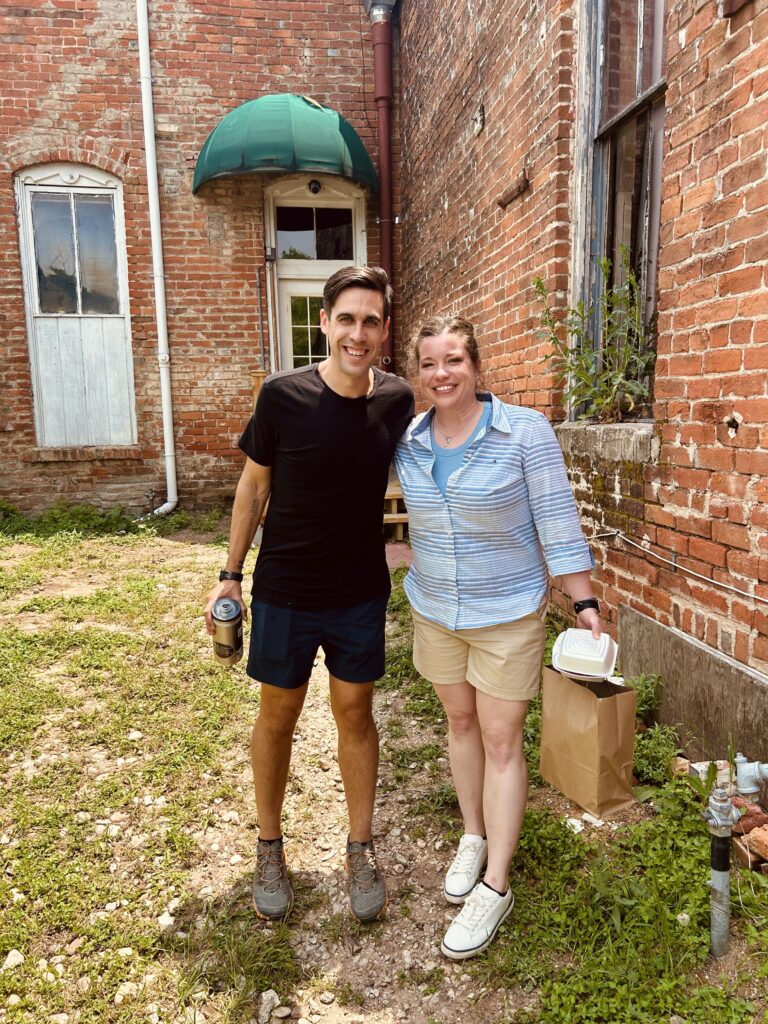
I shook his hand and told him how long I’d been following him and his work, and he seemed genuinely surprised and flattered. He asked us where we were from and what we’d been up to and what books we picked up. Courtney said something that made him laugh, and then she took a picture of us.
I don’t say this lightly when I say he could not have been sweeter to us. Just the nicest guy. I don’t remember much of what I said, but Courtney assured me it was nothing weird. One thing I do remember was tearing up, looking him directly in the eyes, and thanking him for everything he’s taught me. It was an experience I will never, ever forget.
One last thing.
While writing this email, I realized that we met Ryan exactly ten years to the month after moving in together. I really am not trying to be sappy, but I feel something essential would be missing from this newsletter if I didn’t state the obvious: I would never have cared enough to learn philosophy if it wasn’t for Courtney. Not only that, she’s been teaching me Stoicism, unknowingly, this whole time. She’s the one who, after I failed the first test I took in my first week back in school and said I was going to drop the class and try it again next semester, put her foot down and said she wasn’t going to watch me quit every time it got hard. She’s the one who showed me what self-reliance looked like. The one who, after I told her my crazy idea to travel 1,000 miles for a bookstore, took her phone out and booked our flight without a question.
While Ryan’s teachings and Stoic philosophy got me on the right course and guided my sail, it’s been my wife, all along, lighting the way home.
Books Read This Month:
-I bought Composed by Rosanne Cash while at The Painted Porch last month. It took a while to get into, but once I did, I thoroughly enjoyed it. One story in particular stuck with me as a beautiful example of kindness. Rosanne was sitting at home and talking with her stepmother, June, when the phone rang. June picked it up, and after a while, Rosanne wandered into a different room—it was obvious June was in a deep conversation. When Rosanne returned to the room 10 or 15 minutes later, June was still fully absorbed in conversation. Finally, about 20 minutes later, June hung up and, with the biggest smile, said what a wonderful conversation she just had. June went on and on about the woman she’d spoken with—how many kids she had, a personal loss she recently experienced, where she lived, etc. Rosanne asked, “Well, June, who was it?” June said, “Why, honey, it was a wrong number.”
–In the Heart of the Sea by Nathaniel Philbrick…wow, this is one of the best real-life thriller/adventure stories I’ve read. An enraged sperm whale sank the Essex whaling ship in the early 1800s. Only 8 out of the 22 on board survived the three months of torture that followed. (Endurance is another shipwreck story I read recently, which was good, but I liked this one more.) I won’t spoil it and give away details, but their ordeal was unimaginable. It reads like a thriller. It’s no surprise it won a National Book Award.
-My friend recommended When the Game Was War by Rich Cohen, and it’s one of the best sports books I’ve read. Cohen brings together the journeys of the NBA’s four most prominent names in the 1980s—Isiah Thomas, Larry Bird, Magic Johnson, and Michael Jordan. It’s an entertaining read, but there’s also great stuff on leadership, craft, and opening doors for others. On a side note, I think we’re living in another golden era of basketball with Caitlin Clark and Angel Reese.
-Though I loved Courage is Calling and Discipline is Destiny, Ryan Holiday’s newest book, Right Thing, Right Now, about justice, might be my favorite of his virtue series. It’s about kindness and doing good for others and ourselves. But it goes way beyond that. He shows how idealism and sentiment aren’t enough. If we want to make lasting changes in the world, we need to understand the force that drives it: power. We may not like it, but that’s the way it is. “Anyone who wants to do good in this world,” he writes, “must be a student of power. Anyone who wants to do something other than sit around and wait for change must read Machiavelli and Robert Greene.” It reads as an urgent wake-up call that the world desperately needs.
P.S. If you’re new to Stoicism, there’s no better place to start than with The Daily Stoic.