Life

9 lessons I’ve learned from 10 years in a relationship

My wife and I celebrated our 10th anniversary this month, and as a gift, I made a little scrapbook of our first 10 years together.

Looking at our first photos—the scraggly, 25-year-old me beaming next to my then-girlfriend—I thought to myself, wow, Emily, you were so clueless.

I spent this month thinking about what makes a relationship work and grow, and what I learned through my own experience.

I came up with a list of 9 lessons I’ve learned from 10 years in a relationship:

1. Ego is the cause of most relationship problems

If I had known the power of humility when I was 25 years old, I would have saved myself years of trouble.

Almost all relationship problems are solved with a genuine I see where you’re coming from. I would feel the same way if I were you. I was wrong. I’m sorry.

It took me a while to feel comfortable saying sorry, but I say it all the time now. It’s great. I say sorry almost too much. (I say almost because every once in a while, when the wind blows in from the east and the sun is shining just so, I’m not completely wrong.)

2. Listen like a best friend

Our partner is supposed to be our best friend. And best friends are inherently good listeners: comforting, helpful, and quick to take our side while also trying to be objective.

We do this too in our romantic relationships. When your partner is venting, you listen like a best friend. You validate their right to be irritated about the crap they had to deal with that day. You throw in a few well-timed hmms and reassuring touches. You describe a similar experience you’ve had so they don’t feel so alone.

But what if the reason your partner is frustrated is because of you?

It’s here where listening and camaraderie are replaced with defensiveness and rebuttals. At least that’s how it was for me. The more I was confronted with my bullshit, the louder the voice in my head screamed that she was ridiculous and harsh.

But, of course, it was me who was ridiculous and harsh, because I wasn’t listening.

Chances are good that your partner isn’t trying to fight. Chances are good they simply want to express a valid feeling to the person they rightfully expect to feel comfortable expressing it to.

Listening like a best friend to your partner’s frustrations even when they’re about you can feel impossible. But it just takes practice. I would know, I’ve had years of it. Courtney has had to have plenty of tough conversations with me about taking accountability, being on time, not staring at people, etc. And I’m grateful for this because it means she cares.

Again, it’s not easy, but it’s what a best friend would do.

3. The 100/0 Rule

This may sound extreme, but a relationship is not 50/50.

A relationship is 100/0.

You have to give everything and expect nothing. It’s the only way.

4. Disagreements are inevitable, arguments are optional

One day at work about 8 years ago, I was talking to a coworker I looked up to and wanted his advice.

“You know how when you’re arguing with someone and—” 

“Whoa, whoa, whoa,” he laughed, putting his hands up. “ I don’t argue with anyone.”

I immediately wanted to argue with him. How can you go through life without arguing? Wasn’t that part of it?

Instead of voicing my confusion, I asked him what he meant.

“It’s simple,” he smiled. “I just don’t argue.”

“But what if you disagree with someone?”

He shrugged. “Then I disagree. Look, if I’m open to hearing what someone has to say, I’ll listen. But—and here’s the important part—before I jump into what I want to say, I first ask them if they’re willing to listen. If they are, cool. If they’re not, no problem. At least I didn’t waste my time talking in vain.”

This was the wildest thing I’d ever heard in my life. 

It was also a huge relief: I never have to argue with anyone again!

Who would have thought you could simply state your point, let the other person state theirs, and do this back and forth without raising your voice or becoming frustrated?

Arguing can feel natural, but it’s not. What’s natural is cooperation. What’s natural is finding common ground for the common good.

5. Yes! as a default response

In 10 years, there’s been maybe a handful of times (mostly at the beginning of our relationship, mostly involving hiking) that I’ve said no to something Courtney wanted to do together. 

Whenever she asks if I want to do something with her, my response is almost always yes! Even if I don’t have much interest in it, I say yes. And I try to be enthusiastic about it.

Want to go to the grocery store together? Hell yeah. Want to work on a 1,000-piece puzzle? Ab-so-fruitly. Want to re-re-redecorate the bathroom because the decorations have become stale and the wall color is boring and don’t I agree? The…ohhh yes, right, the wall color. Bathroom. Boring for sure. I definitely noticed. Let’s do it!

I do this for two reasons: Because I love hanging out with her and because life is offensively short. At the end of my life, whether today or tomorrow or 80 years from now, I know that I will give anything for one more car ride, one more evening routine, one more anything with her. I try my best to remember that and live by it.

6. Conserve your energy

The other day, Courtney and I were watching a show where this engaged couple was in a heated discussion, trying to get on the same page. It ended when the guy walked away saying, “I don’t have the energy for this.” All I could think was, Bro, what the hell else are you using your energy for?

Most of what we do is inessential, and we drain precious time and energy doing it.

You had the energy to follow sports updates and bet on the games, but none for a meaningful conversation with your partner? C’mon. You followed breaking news and now you’re too frazzled to greet your partner with a smile when they get home? That’s not fair.

I used to misplace my attention like this all the time. No one I knew was further along in Candy Crush than me (making me a winner and a loser at the same time).

Once I learned how to ruthlessly eliminate the inessential and be still, I grew as a person and partner.

7. Keep it playful

It’s not that serious. Be goofy and silly together. Laugh at yourself. I swear I never laugh harder than when Courtney roasts me. I even write down her roasts of me on notecards and read them later when I want a good laugh.

8. Follow through

If you say you’re going to do something, do it. And if there’s a chance you might not do it, don’t say you’re going to. Better still: just do the thing and don’t talk about it.

9. Fill your home with virtue

I almost didn’t include this one because it sounds kind of corny, but I decided it’s too important to leave out: a house filled with virtue is more beautiful than a house filled with gold.

Selflessness, transparency, honesty, laughter, spontaneity, routine, love, calm, kindness, acceptance, patience—fill your house with these things and you will have the most beautiful, joyful dwelling in the whole world. You’ll have the most beautiful, joyful relationship too.


Books read this month:

-My dad gave me his copy of A Confession by Leo Tolstoy and it’s one of the best books I’ve read. It’s answered some of the questions I’ve had for years about religion and faith. If you’re even a little curious, it’s well worth the read. And if you haven’t read his A Calendar of Wisdom, you need to!

On Writing by C.S. Lewis. A compilation of writing advice from one of the best. My biggest takeaway: reading a book just to get to the end is vulgar. The whole point is to enjoy the book as you read. I thought about this the other day when Courtney and I planned to go for a hike and then go out to eat afterward. I was excited, but mostly about the food part. The hike was something to get through. Lewis would call this vulgarity. By thinking of food as the payoff, I was thinking about, well, the payoff. But thinking about a payoff cheapens life. There is no eventual payoff. The payoff is this moment, right now. Besides, everything we do—the stuff we like and dislike—it all passes by anyway. We’re here for a short time and then the lights go out. Don’t wish away a second of life by anticipating something else. There is no something else. This is it. Don’t forget to live.

-I first read Keep Going in 2021 and I decided to read it again because I love Austin Kleon. He posts his work on social media every day—a journal entry or a collage or a pile of vinyl records he melted in the sun—the message being that’s important to create for its own sake. He recently inspired me to start a collage journal of my own and I’m having a lot of fun with it.

William Blake vs. The World by John Higgs. I knew nothing about William Blake before reading this, and WOW, what a phenomenal book. Tons of thought-provoking ideas on imagination. I especially loved the parts about human perception and how, outside of the human mind, we have no idea what the universe looks like. Whoa.

David Sedaris Diaries: A Visual Compendium by David Sedaris. I’ve been a fan of David Sedaris for about 20 years now and decided to give his mostly visual book a read. I LOVED it. If you get inspired by looking through people’s journals and diaries like I do, you will love it. It’s a compilation of pictures of and passages from the diaries he’s kept throughout his life. I was inspired by the way he finds trash on the street and turns it into art. Or turns it into nothing and simply binds it in his diary as is. Because he realized, he explains, that when he sat down at his desk to write in his diary, “I could really do whatever the f— I wanted.”

Commit once and for all

About a month ago, a new policy was announced at work.

It wasn’t anything crazy, but I was annoyed, and I complained to Courtney and my parents. The more I thought about it, the more miserable I made myself.

A few weeks later, I was notating Epictetus’s Enchiridion.

“You want to win at the Olympics? So do I—who doesn’t?” Epictetus said to a student. But before you jump in, reflect on what that entails: you’ll need to adopt a strict diet, a brutal exercise regimen, and submit completely to a trainer. Your ankles will likely swell. You’ll sustain injuries and swallow mouthfuls of sand. Oh and after all that you still might lose.

If, after considering everything you’ll have to do, you still want to be an Olympian…then do it wholeheartedly, he said. Don’t pause to think about it or you will end up jumping from one infatuation to the next. You’ll be like a child; one day they want to be a gladiator, the next day a musician, the next an actor, and so on. Give your pursuit sincere attention and commit with all your heart.

He then applies this lesson to life.

You claim to want serenity and freedom and peace, but are you willing to pay the price? Are you willing to change the way you eat and drink? Are you willing to put up with nights of pain? To be criticized? To forfeit status and power? Willing to moderate your desires and aversions? To be okay with getting the small end of the stick in even the tiniest matters? In a word, are you willing to live as a philosopher?

If you’re unwilling, don’t go near it, he says. Walk away. You can’t be a philosopher one day and someone else the next. You can only be one person. Make your decision, and commit once and for all.

This struck me with a force that’s hard to describe.

You say you want freedom, yet here you are, troubled.

Commit once and for all.

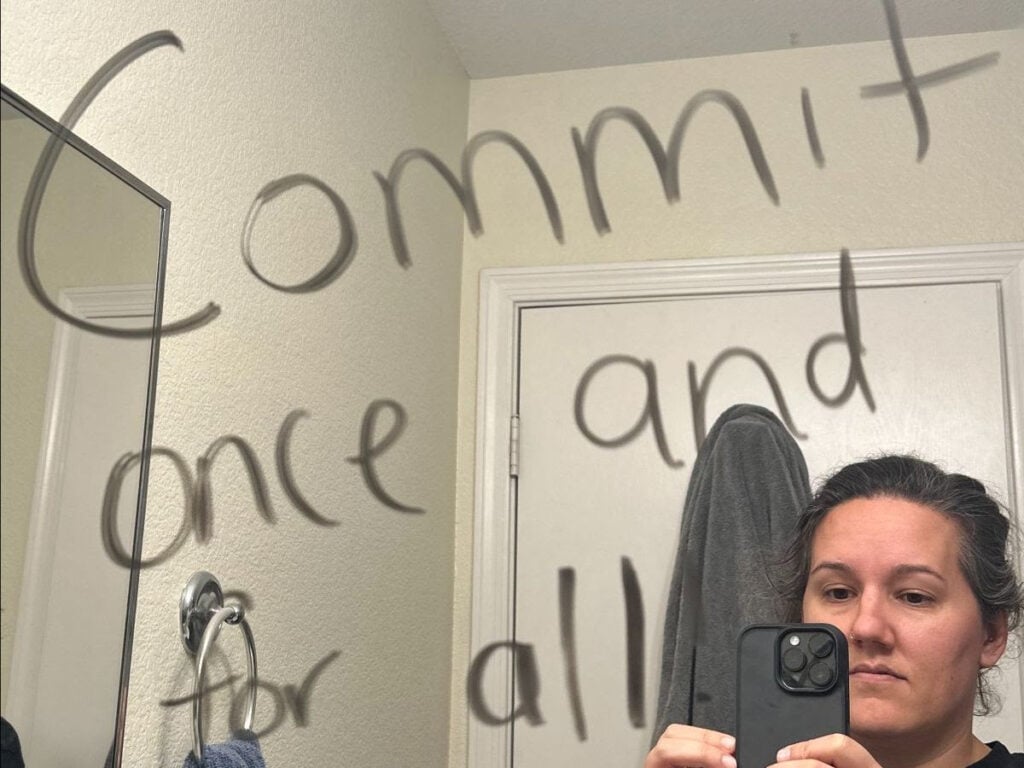
Every day the next week, I wrote, “Commit once and for all” on the back of my hand. I took a thick, black Expo marker and scrawled the phrase on the bathroom mirror. I needed reminders. I had been using philosophy in some parts of my life, but clearly not in others. 

One of my favorite passages from Epictetus is where he says if people truly grasped how short life is, they would never entertain miserable thoughts. He didn’t say they would never entertain a miserable thought unless something seemed unfair, or unless a situation felt overwhelming, or unless someone pissed them off. They just wouldn’t entertain those thoughts, period.

It’s important to note that he wasn’t talking about negative thinking, which we know can be used, paradoxically, to increase positivity. He was talking about thoughts that do nothing but make you feel miserable.

Epictetus spent the first 30 years of his life as a slave. One day, his master, feeling especially cruel, grabbed Epictetus’s leg and began to twist it. “If you keep doing that,” Epictetus told him, “you’re going to snap it.” The master kept twisting. Epictetus’s leg snapped. “See,” Epictetus said calmly. “I told you that would happen.” 

It’s not that Epictetus didn’t feel pain. Of course he did. But his philosophy said things outside of his control could not harm him. That his leg is broken? That is objectively true. That he’s harmed by it? That was up to him. And his commitment to his philosophy was greater than his broken leg. 

Seneca had a respiratory illness that sometimes made it hard to breathe. When it flared, he would spend days in bed, in a state of near suffocation. Writing about these experiences to his friend Lucilius, Seneca said that even though his body was in anguish, his mind was at ease. “Even while suffocating,” he reflected, “I did not stop resting serenely in brave and cheerful thoughts.” The Epicurean philosopher, Epicurus, was in excruciating pain on what he knew would be (and was) his last day on earth. Still, he wrote that he felt a “gladness of mind” by recalling pleasant memories of conversations with friends.

Like Epictetus, Seneca and Epicurus were not immune to pain. In fact, their empathetic natures probably amplified their pain at times. But here they were, nearly suffocating and dying, still committed to their philosophy, still not letting outside things harm them, still feeling “gladness of mind”. Not in a “toxic positivity” way—they weren’t smiling and saying, ‘Aw gee, shucks, isn’t this great?’—but in the contented way that comes from soberly processing negative emotions and calmly accepting what they could not control.

These were people who were committed. This is who they were; the situation wouldn’t change them.

Commit once and for all. This was my wake-up call and a reminder that I can’t pick and choose where I use philosophy. Like an Olympic athlete, I must be totally committed. 

So a policy changed at work? And? Why are you thinking about it now anyway?  It doesn’t take effect until next year. Besides, think of how lucky you are to have this job and the wonderful people you’ve met because of it.

You’ll find a way to use this to your advantage. You’ll see it’s for the best.

P.S. It turns out the new policy won’t change things that much. This brings to mind another stoic principle I had disregarded: don’t suffer before it’s necessary or you’ll suffer more than is necessary. But more on that another time.

P.P.S. Courtney woke up to my mirror reminder. She sent me this pic while I was at work, saying it had scared the shit out of her.

Books Read

-I loved The Devil in the White City by Erik Larson. It’s a story about the Chicago World’s Fair, the architects who built it, and the serial killer who used it to lure his victims. What makes it even creepier is that it’s true.

How To Do the Right Thing by Seneca was great. It’s part of the Ancient Wisdom for Modern Readers series, a collection of books that take individual philosophers’ works and piece together writings on a narrow topic. Other books of theirs I’ve enjoyed: How to Be Free, How to Keep Your Cool, How to Be a Leader,How to Be a Bad Emperor, How to Give, How to Be Content.

-I loved Morgan Housel’s The Psychology of Money, so I preordered and read his newest book Same as Ever, a collection of stories about what doesn’t change. I found some great reminders: the better story wins, risk is what you don’t see, the magic of compounding. Other topics that made me think: the importance of imperfection, the short lifespan of competitive advantage, and the simplicity of most things (and how and why we complicate them).

-I was hesitant to read Elon Musk by Walter Isaacson because I wasn’t sure how transparent it would be. But then I saw that Isaacson referred to Musk as a man-child, and I dove right in. Wow…this is one of the best books I’ve read this year. It’s an up-close view of how one of the most wildly successful entrepreneurs operates and makes decisions. It made me see Musk in a new light. I had a hard time putting it down. A very hard time. The short chapters and loads of pictures made it a fast read too. I didn’t want it to end.

12 more things I learned or found useful in 2023

1. We don’t need more time, we need more focus. We all have the same, fixed amount of time in a day. But with a little mindfulness, we can expand our time. Think about all the things you can do in 15 minutes. You can read a few pages of a book. You can call your mom. You can help your spouse prepare dinner. Now think about all the ways 15 minutes can slip by without notice. Scrolling through newsfeeds, small talk, zoning out in front of the TV. Seneca put it best when he said that time doesn’t slow down to let us know it’s passing by. It’s our responsibility to mind it. We can’t create more time, but we can put the time we do have to good use.

2. The best way to show someone respect is by doing your best.

3. Donald Miller said, “A good movie has memorable scenes and so does a good life.” I’ve been thinking about this lately, especially when I’m out with family and friends. What’s a little extra something we could do to make this more memorable?

4. Don’t let your days become one chore after another. Life requires balance. And space.

5. Setting time limits can relieve stress. For almost a decade, I’ve had the same system for notating the books I read. After I finish a book, I put it in a “to-notate” pile. Later, with notecards and pen in hand, I systematically go back through them and jot down the parts I marked. Recently, I was overwhelmed by the ever-growing stack of books in the “to-notate” pile. This was supposed to be fun, not stressful! So, I decided to impose a time limit. I don’t allow myself to take notes for more than 2 hours a week (or roughly 10-20 minutes per day). Putting this limit on myself made the process fun again and allowed me to enjoy my free time more. Plus, the time limit forces me to write down only the best stuff from each book. Then, on to the next.

6. Getting up early is the key ingredient to living a better life. Ernest Dimnet said, “An hour in the morning is worth two.” I’ve thought about that for years now, and it’s true.

7. I’m always thinking about how short life is. Or rather, I’m highly mindful of how I spend my time. Or, perhaps more precisely, you could say I’m obsessed with weeding out the inessential from my life. (Sometimes to a fault). Why would I accept a promotion if it meant less time with my wife? Why would I allow my schedule to be too packed to see my parents every week and help them when they need it? Why would I spend an hour at the grocery store when I can spend an hour outside playing with my dog and have the groceries delivered?  Why would I go to a gym when I have the equipment at home? I can imagine someone reading this and thinking, gee whiz, just live your life. But to me, this is living my life! Hanging out with my wife, helping my parents, playing with my dog, creating space for spontaneity—that’s the stuff that makes life worth living (and makes me the luckiest person)! That’s how I want to live my life, surrounded by what’s most important. The 2 quotes I read this year that have really shaped my thinking on this:

     Epictetus: “If we keep in mind constantly how short our life is, we will realize there is no room for excess.”

     Seneca: “We don’t have enough time for what’s necessary, let alone what’s unnecessary.”

8. What if we replaced the word envy with admire? We can be quick to shut down thoughts of envy. But, Alain de Botton says, if we take a moment to explore this feeling, we may find what lies beneath is not envy, but admiration. And we usually don’t envy someone’s entire life. Usually, it’s just a part that we envy (admire). And once you’re clear about what you admire, you can work to incorporate it into your own life. Let’s say you envy a successful entrepreneur’s life. You dig a little deeper and realize you don’t actually envy her life—it’s too hectic. What you envy, or admire, is her flexible schedule. Knowing precisely what it is you admire—her autonomy—gives you a clearer vision of what you’d like in your own life. You can then take steps and, say, make a career change to have more flexible work hours. You can repeat this process on multiple people, taking bits and pieces you admire, and fitting them together to create your ideal life.

9. With anything you endeavor to do, the whole point is to have fun. Do the things that you find most interesting.

10. Richard Feynman on happiness: “My rule is when you are unhappy, think about it. But when you’re happy, don’t. Why spoil it? You’re probably happy for some ridiculous reason and you’d just spoil it to know it.”

11. A contented state of being is the most sustainable form of happiness. Epicurus placed pleasure into two categories: active and static. Using food as an example, active pleasure is the pleasure you get from eating. Static pleasure is the pleasure of no longer being hungry. Epicurus believed static pleasure to be superior. When it comes to eating, the ultimate goal is not more pleasure from more food (active), but the contentedness of not being hungry (static). Active pleasures create a desire for more, meaning there’s never enough. Static pleasure is at total peace in and of itself.

12. I’ve been thinking about a quote of Stephen Marche’s every time I want to end my workout early: “Without struggle there is the struggle of no struggle.”

Books Read

-I read Killers of the Flower Moon by David Grann and wow. Wow, wow, wow. In the 1920s, members of the Osage Nation in Oklahoma were mysteriously killed, one by one. It’s a shocking true story of greed and betrayal. I audibly gasped a few times while reading. Like the book Dead Wake (see below), it’s the perfect mix of history and suspenseful storytelling.  

What I Talk About When I Talk About Running by Haruki Murakami. I LOVED this book. It’s a memoir centered on running and how it facilitates his writing. Making a living as a novelist for more than 40 years takes an incredible amount of stamina. Most authors write a novel or 2, then move on to something else; life as a novelist is too hard to sustain. Murakami credits his career longevity to the physical limits he pushes himself to through running. I found the book inspiring and a kick in the ass to push myself harder during my runs.

-After reading The Splendid and the Vile last month, I became an Erik Larson fan. This month I bought and read Dead Wake: The Last Crossing of the Lusitania, and oh my gosh, it was so good. One of the things I love about Larson’s writing is the anecdotes he uses: a person’s frivolous yet telling quirks, the personal struggles of famous men and women, etc. Maybe the best of what he includes is the stuff he personally found most interesting. Like all good writing, his works center on the people, not just the events. On the why behind the what. This book also reads with such slow-building suspense that I had difficulty putting it down.

Be Useful: Seven Tools for Life by Arnold Schwarzenegger. I was skeptical about reading this book, but I’m glad I did. It centers around this idea: be useful. Whatever you’re doing, be useful. If you don’t know what to do next, be useful. Your definition of being useful may be different than someone else’s, but that doesn’t matter. Be useful. Another message I got: you don’t have to always default to paying your dues. Sometimes you have to make a giant leap. (When he was just starting in movies, Arnold didn’t go for little parts here and there, he went for the starring role. In politics, he didn’t run for mayor or city council; he went straight for governorship.) Another message I liked: “Break the mirror”. Know the face of your neighbor better than your own. Focus your attention outward, on helping others. Inward focus is important too, of course, but the underlying reason to become personally successful (a reason I also firmly believe), is not so you can buy a larger house or take more vacations, but so you can do the greatest amount of good for the greatest number of people. This is the best reason for wanting to succeed.

-I loved Haruki Murakami’s book on running and writing so much that I decided to read another book of his, this one on just the writing: Novelist as a Vocation. I loved it. LOVED it. He writes so candidly and honestly that reading him feels like you’re reading a letter from a friend. And it’s filled with wisdom about writing.

Scroll to Top