13 things I’ve learned from keeping a journal
Each weekday morning, I sit down and write 3 pages in my journal first thing.
I don’t have a plan for what I write, just whatever is on my mind. If I have nothing to say, I’ll write, ‘I have nothing to say’ over and over until something else comes out.
There are different ways to think about journaling. One way is to journal with a sort of pre-planned direction. You sit down to record the day’s events, or a new recipe, or ideas for a project.
Another way to journal is to just write. Even if—especially if—you feel like you have nothing to say.
This method is what Julia Cameron coined Morning Pages: “three pages of longhand, stream of consciousness writing, done first thing in the morning.”
That’s it. There are no rules. Just write 3 pages and do it again the next day.
It’s simple but so, so powerful.
I’ve used this method to journal for a long time. Below are 13 things I’ve learned in the process:
1. Paying attention to my life = happiness
People are often surprised when I tell them I write 3 pages in my journal each morning. They give me a look that says why would you do that to yourself? Then they ask, “How do you have that much to say?”
But it’s not about having something to say.
I write down what I’m thinking at the moment—what I’m excited about, what I have to do that day, how good a brownie sounds.
The point is that even on days when the only words rolling off the nib of my pen are the lowest-hanging fruits of thought and the shallowest observations, I’m still benefiting. I’m still noticing things about myself. I’m still clearing my mind for a calmer start to the day, still spending time with my thoughts.
In short, I’m paying attention to my life. And I’ve noticed that when I’m paying attention to my life, that’s when I’m happiest.
2. Self-reflection is the highest form of living
Epictetus said we differ from animals and plants in two ways: we can reason and reflect—two things animals and plants don’t need because they were made to obey, not command.
Our ability to look inward is our superpower.
Animals can look only outward and dream. Humans can look inward and, as Carl Jung said, awaken.
3. It’s not about productivity
Years ago, I read an article by an author who said morning pages were a waste of time. She had pages and pages of writing, she complained, but nothing publishable. I remember feeling the same way about my morning pages. I could be producing actual content in the real world. I could be getting things done. Yet, here I am, hunched over my journal writing gibberish.
But I was missing the point.
I don’t journal to “be productive”. I journal to calm and prepare myself for the day (ironically making me more productive throughout).
4. The space between self and mind
The Buddha became enlightened when he stopped identifying with his personality and became a witness to his intellect.
The essence of yoga and meditation is to arrive at the space between yourself and your mind. In this space, you’re free from limitations. Your sense of clarity and perspective is heightened, along with your freedom.
We can access this space whenever we want by opening our journal.
5. You can’t be your best on autopilot
Even the wisest people regularly ask themselves what’s right, where they can be better, how they can improve.
Why?
Because they’re not perfect. None of us are.
And because we’re not perfect, we can always improve. And because we can always improve, we have an obligation to make a constant effort to improve. And effort isn’t made on constant autopilot.
Journaling takes us off autopilot for a bit.
6. It’s not an art project
Journals should be messy. If the inside of your journal is clean and neat and completely coherent, you’re probably doing it wrong.
As the manager of a deli where I once worked said to me after witnessing my meticulous sandwich-making, “What in the hell are you doing? It’s not an art project.”
Austin Kleon put it brilliantly when he said his journals are crapholes where he goes to dump his brains out.
Because there’s only one rule when it comes to your journal: fill it.
7. A way to savor life
Time rushes by like a raging river. The only way to slow it down and savor it is to slow ourselves down.
8. Your subconscious knows you best
Your subconscious is wise. The problem is that it’s terribly quiet and shy. It often won’t respond to direct questioning.
That’s where journaling comes in.
Journaling creates a patient, quiet, purpose-free space for your subconscious thoughts to roam freely. Only then, in familiar solitude with you, do they feel comfortable to speak up. And when they do, they’re assertive.
A while back, morning pages helped me decide on something I’d been wrestling with for months. And because the decision stemmed from my journaling, from the deep convictions of my heart—not a flimsy pros and cons list—my resolve was unflappable. “I’m thinking about going back to school” became “I’m getting my degree and no one is going to stop me.”
9. Rewrite your software
If we don’t monitor our thoughts, we become vulnerable to their influence and control. We can end up living in the worst way: unconsciously.
Lusting for money, worshiping material things, seeking power, thinking you’re the center of the universe…what’s insidious about these things “is not that they’re evil or sinful,” said David Foster Wallace, “it is that they are unconscious.”
Journaling is a spiritual process, and as Sadhguru said, “A spiritual process means we have made up our minds to rewrite our software, consciously.”
10. Examine the contents of your mind
Our minds are a jumble of random, conflicting, bizarre, and often incoherent thoughts. They have a life of their own. The cringey thing you said when you were 8 may subconsciously be causing you distress 40 years later. The apology you so desperately want from a family member may be the hidden roadblock keeping you from feeling fulfilled.
By dumping out our thoughts and feelings, by laying them before us, we’re able to sift through, untangle, and examine them. And discard the ones that no longer serve us.
11. Keep the important stuff in the forefront
Epictetus said our predicament is that time and again, we lose sight of what’s important.
The truth never changes. Wisdom is always the same. Our brains are just exceptionally good at forgetting.
Journaling helps to keep the right things front and center.
12. It doesn’t need to solve your problems
Problems don’t need to be completely resolved for you to gain some relief from them.
Same with negative emotions. Sometimes we can loosen the grip of a sadness or a fear simply by naming it, by tracing its outline and examining its contours.
“What we call depression,” Alain de Botton said, “is in fact sadness and anger that have for too long not been paid the attention they deserve.”
13. Great things are happening in slow, inconspicuous ways
Let’s say you’re on a plane in Los Angeles, California that’s headed to LaGuardia airport in New York.1 The plane is sitting on the tarmac, pointing directly at LaGuardia. If the plane is off by just one degree (about a centimeter) by the time it flies across the country, it’s going to land roughly two states away from its intended target.
The trajectory of your life is made up of subtle, consistent, nearly imperceptible actions.
It may not feel like it at the time, but the small moments you spend each day writing in your journal, working on yourself, are adding up in unfathomable ways.
“If you can see all of the consequences of your actions,” Leo Tolstoy said, “then your actions are of no consequence. . . . All great things are happening in slow and inconspicuous ways.”
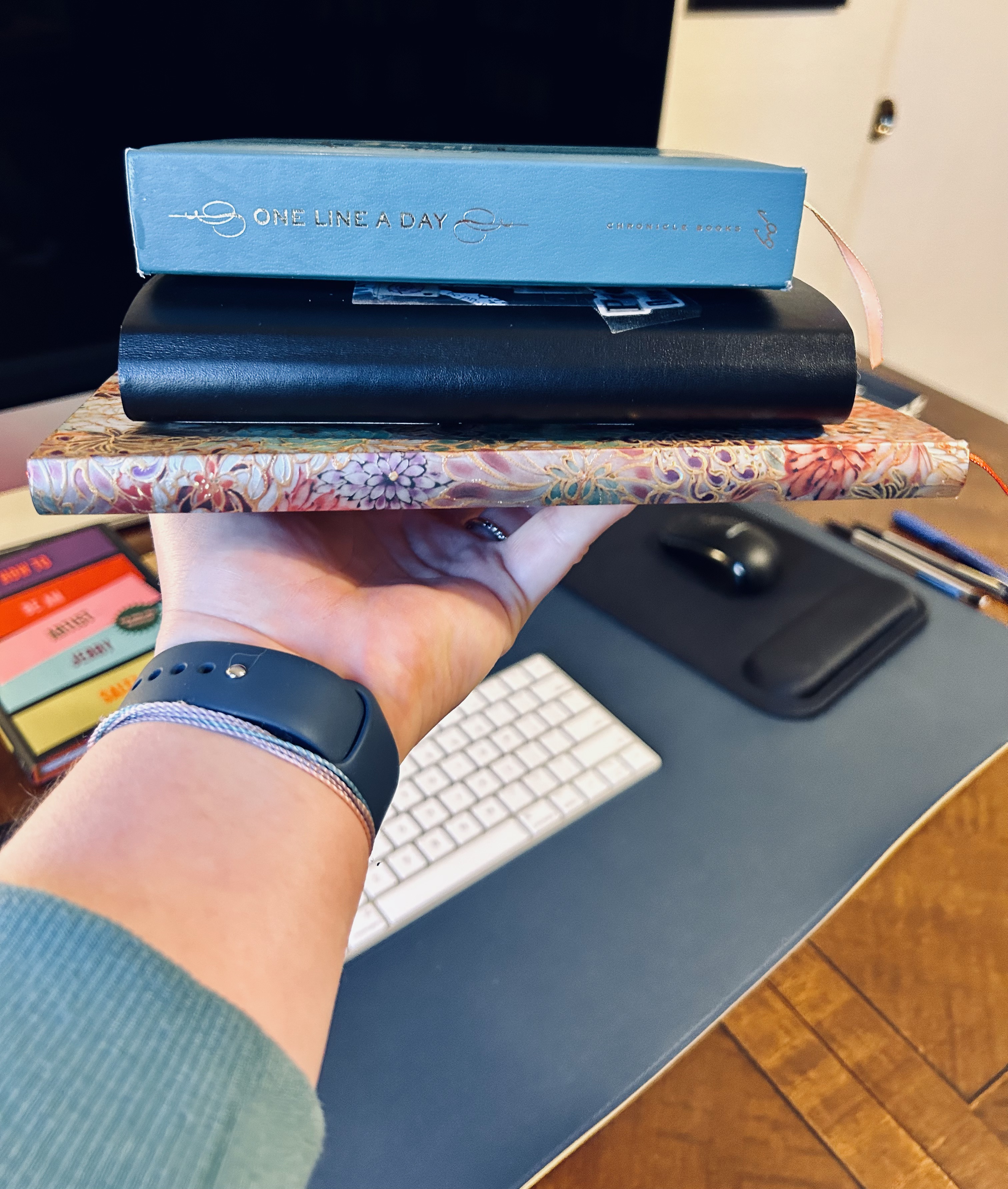
P.S. For those who are curious, I use 3 daily journals. I like Peter Piper Press journals or Paperblanks for my morning pages, Zequenz journals with blank paper for collages/drawings/thinking by hand (which I just started this year and I’m having SO much fun with), and a five-year, one-line-per-day journal where I write a line or 2 about what I did that day.
Books Read This Month:
-I always feel inspired to create after reading Austin Kleon’s work. This month I reread Show Your Work and it had my creative juices all fired up again.
-I finally read the short creativity classic Letters to a Young Poet by Rainer Maria Rilke and I loved it.
-I didn’t know anything about the philosopher Ludwig Wittgenstein before finding and reading his Private Notebooks: 1914-1916. What a delightful surprise! He candidly documents his life as a foot soldier in the Austrian army. His saving grace throughout the war? To be able, in his free time, to do his own philosophical work.
-David Sedaris’s Happy-Go-Lucky was, of course, hilarious. The margins of the book are full of LOLs and Lmaos.
-I’ve been reading a few pages of The Daily Henry David Thoreau by, well, Henry David Thoreau every night and I LOVE it. It’s a compilation of his journal entries and other writings, in a one-paragraph-per-day format. Thoreau lived by the seasons and said that any revelation found in a book was nothing compared to the revelations found in nature. So much good stuff in here.