Monthly Top 10

10 things I learned, found interesting, or used this month

1. Seneca wrote a few of my favorite quotes about gratitude. He said if we’re not grateful right now, we will never be grateful, even if we’re given the whole world.

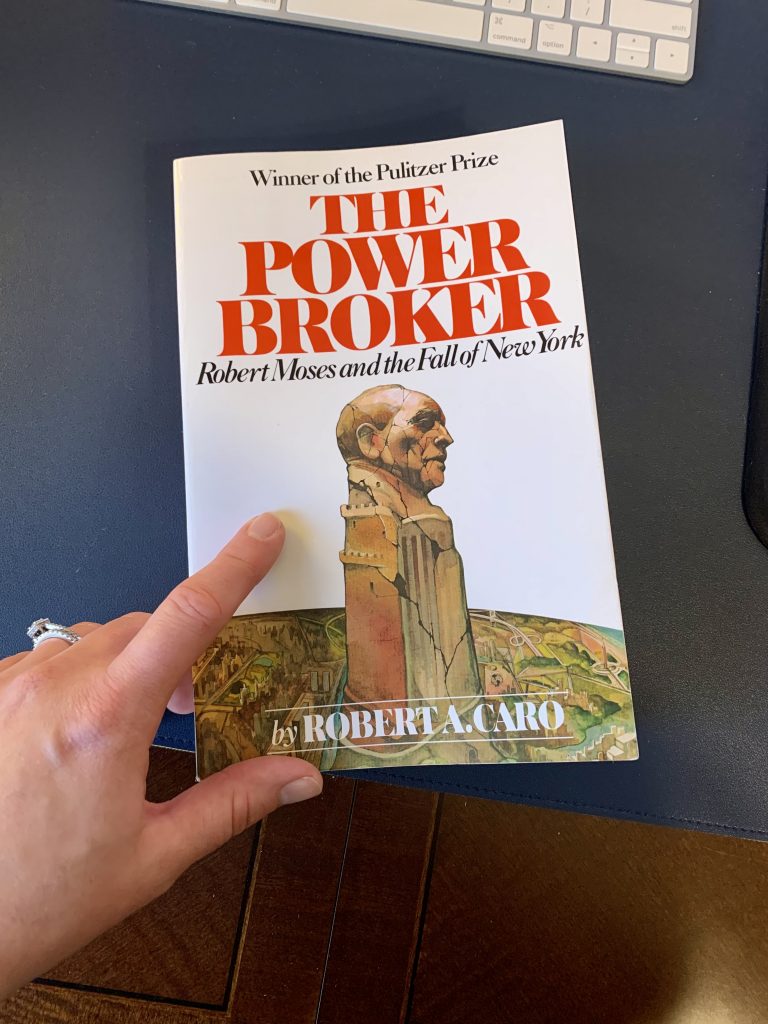
2. I’m currently reading the mammoth 1,162-page biography of Robert Moses, “America’s greatest builder”, who shaped most of New York City. I’m about halfway through and so far and it’s fascinating. It’s a jarring, behind-the-scenes look at how government works and how one man came to, and fell from, power.
3. Emotional intelligence doesn’t have to be complicated. It’s mostly a matter of ego.

4. The 100/0 Rule. At eighteen, Darren Hardy went to a seminar where the speaker asked the audience, “‘What percentage of shared responsibility do you have in making a relationship work?’” Audience members shouted out numbers like 50/50, and 51/49, and 80/20. The instructor turned around and wrote on the board: 100/0. “‘You have to be willing to give 100 percent with zero expectation of receiving anything in return’, he said. ‘Only when you’re willing to take 100 percent responsibility for making the relationship work will it work. Otherwise, a relationship left to chance will always be vulnerable to disaster.’”

5. Listen ten times more than you speak. Musonius Rufus said only a slave would be concerned about her voice being heard.

6. Be like a smelly goat. Marcus Aurelius said, “The straightforward and good person should be like a smelly goat— you know when they are in the room with you.” Live straightforwardly, he told himself. Let every utterance be truthful, so no one ever has to question your motives.

7. Contemplate the swings of fortune. Not talking or thinking about loss or death doesn’t mean it won’t happen. It just means it will be all the more distressing when it inevitably does.

8. Love isn’t about someone else. It’s a way of being.

9. Clear the mental and physical clutter. I taped this quote from Discipline is Destiny to my computer: “A person who doesn’t eliminate noise will miss the message from the muses.”

10. Notable books I read this month: The Boys in the Boat by Daniel James Brown, Shop Class as Soulcraft by Matthew B. Crawford

10 things I learned, found interesting, or used this month

1. If everything seems under control, you’re not going fast enough.

2. 10 in, 1 out.
In order to have 1 good idea, you need to consume 10. 

3. Let it float on by. I’ve been thinking a lot lately about discarding thoughts: if a toxic thought pops into my head, I can immediately discard it. When I told my wife about this, she pointed out that in order to discard something, I first had to possess it. It’s better, she said, to watch the thought from a distance, and let it float on by.

4. The 40% Rule. Jesse Itzler learned the 40% Rule from a Navy SEAL he lived with. “He would say that when your mind is telling you you’re done, you’re really only 40 percent done. And he had a motto: If it doesn’t suck, we don’t do it.”

5. Bore yourself into good ideas. The philosopher Leo Tolstoy said that when our minds are calm, useful thoughts appear. Austin Kleon, in his classic book on creativity, talks about his love for ironing shirts. “It’s so boring. I almost always get good ideas.”

6. When reading a biography, it’s more important to understand the person’s motives, rather than the events.

7. Clean up your desk. I loved this chapter in Discipline is Destiny. We waste so much time scrolling, shuffling, and moving things around just to do simple tasks. “A person who puts up with needless friction will eventually be worn down.” I consider myself to be fairly tidy but I used some of the ideas from the book this month to tidy up even more: I donated a grocery bag of pens and pencils to a local school. I moved extra highlighters, Sharpies, and anything else I rarely use, to the closet. Finally, I cleaned up my writing desk (separate from my work desk), keeping only the bare minimum: a computer, lamp, pen, pencil, planner, and notecards. Another cool idea: use a table as an office desk. Things are more likely to get done when there are no drawers to shove them into.

8. Be content to be thought foolish. This is one of my favorite quotes from Epictetus: “If you wish to improve, be content to be thought foolish or stupid.” Who cares if you don’t know who won last night’s game? Or that you haven’t heard the latest scandal everyone’s talking about? If you wish to acquire wisdom, Epictetus said, you have to be okay with appearing ignorant. Further, you don’t have to have an opinion. Let other people talk and gossip and argue. Your mind will be clear and tranquil, and you’ll have more energy for your own improvement, and your own work.

9. Everyone is doing their best with what they’ve been given. Socrates said that no one does wrong on purpose.The logic, of course, is that people who do wrong are harming themselves, and since people don’t harm themselves on purpose, they don’t do wrong on purpose. I really liked how Ryan Holiday wrote about it: People are doing the best they can with what they’ve been given. They weren’t given your brain, your experiences, your circumstances, your influences. The friend who repeatedly makes destructive choices, the sister who just can’t seem to get it together—surely they wouldn’t act this way if they knew the harm they were causing themselves. They wouldn’t act this way if they could help it. They’re doing their best, as we all are. If they’re open to advice, give it. If they’re not, let them be. Focus on the good in them. There are things that they’re better at than you. Learn from them. Most of all, love them. And be grateful with all your heart for the opportunity to share this beautiful, brief existence with them.

10. Notable books I read this month:How to Live: Or a Life of Montaigne in One Question and Twenty Attempts at an Answer by Sarah Bakewell, Discipline is Destiny by Ryan Holiday, First We Read, Then We Write by Robert D. Richardson, The Perfect Pass by S.C. Gwynne, How To Be a Bad Emperor by Suetonius

10 things I learned, found interesting, or used this month

1. Align your will with nature. This month I talked about how the Stoics aligned their will with nature by accepting what was outside of their control. This is how Epictetus might have advised me if my intention was to go to a football game and keep my will aligned with nature: Mentally rehearse what a football game entails—obnoxious people, expensive food, maybe someone will spill their beer on you. Remind yourself that nothing can go contrary to your wishes if you wish for things to happen the way they happen. If someone ends up spilling beer on you, remember that your intention was to keep your will aligned with nature, “which is impossible if [you] go all to pieces whenever anything bad happens.”

2. It’s just a number. Dr. Edith Eva Eger confided in her principal that she was considering getting her doctorate in psychology. Her only hesitation, she told him, was that by the time she earned it, she would be fifty years old. Her principal smiled at her and said, “You’re going to be fifty anyhow.” From that moment, she decided never again would her age keep her from doing what she wanted. She went on to earn her Ph.D. and become a world-renowned psychologist. She’s 95 years old and still practicing.

(Source: The Choice, Dr. Edith Eva Eger)

3. What you do after you hit the wall is where you gain the advantage. There was a time in each race when cyclist Lance Armstrong would hit the wall. Legs on fire, body screaming for a reprieve, he knew his competitors were feeling the same. This low point was precisely where he would gain the advantage. He would push past his limits and win the race. “No one is better at suffering than me,” he’d say.

(Source: The Compound Effect, Darren Hardy)

4. What you do after you hit the wall is where you multiply the results. Arnold Schwarzenegger, like Armstrong, exploited this power that existed on the other side of the wall. Lifting weights, he wouldn’t stop after his last rep; when he maxed out, he would use other muscles to “cheat” and pump out a few more reps—exponentially multiplying his results.

(Source: The Compound Effect, Darren Hardy)

5. It’s much better to read books that will enrich your life, rather than your career.

6. Focus on insignificant things, get insignificant results

7. The higher tempo wins. The world’s greatest American fighter pilot John Boyd said the side with the higher tempo (quickness in tactical changes, staying one or two steps ahead of the enemy) wins. Ten-time championship-winning college basketball coach John Wooden conducted all his practices at a high tempo. In fact, his players were so accustomed to the quick pace of practice that the actual games felt slow in comparison. Opponents couldn’t keep up with their high tempo.

(Source: Boyd, Robert Coram, & Wooden, Coach John Wooden)

8. Balance fast and slow. Similar to make haste, slowly, and keeping a higher tempo, John Wooden said, “Act quickly, but don’t hurry.” He explains, “When you hurry, you tend to make mistakes. On the other hand, if you can’t execute quickly, you may be too late to accomplish your task. It’s a delicate but critical balance.” 

(Source: Wooden, Coach John Wooden)

9. My favorite author Ryan Holiday released his newest book this month: Discipline is Destiny

10. Notable books I read this month:Wanting: The Power of Mimetic Desire in Everyday Life by Luke Burgis, A Better Man by Michael Ian Black, How the Word is Passed by Clint Smith, Put Your Ass Where Your Heart Wants To Be by Steven Pressfield

Scroll to Top