A Marriage at Seaby Sophie Elmhirst The sea has a way of stripping life down to its essentials—danger, luck, courage, despair. A Marriage at Seais the true story of a married couple who, in 1972, set out to sail the Pacific, a lifelong dream. Everything was going great…until a whale smashed into them, tore a hole in their boat, and sent it to the bottom. Suddenly they were stranded at sea. For months. What unfolds is a tale of love and boredom, despair and stubborn optimism, and the sheer grit it takes to survive. It’s a survival story that reads as easily as a novel.
With the Old Breedby E. B. Sledge After finishing the phenomenal Company Klast month, I found myself still in the mood for war writing. With the Old Breed is called one of the most unflinching memoirs of World War II, and now I understand why. Sledge writes plainly about what he witnessed and felt while fighting at Peleliu and Okinawa—battles whose necessity has long been questioned—and you can’t help but shake your head in amazement at the bravery…and the waste.
You Could Make This Place Beautifulby Maggie Smith As you know, I love a good memoir. I really enjoyed this one, especially how she wove her poems throughout. The title comes from a line in her poem “Good Bones”—one of my favorites—which Meryl Streep read at the Academy of American Poets’ fifteenth annual Poetry & the Creative Mind gala. This book is about heartache and rebuilding, and finding beauty where it feels hardest to see.
Marcus Aurelius: The Stoic Emperor by Donald J. Robertson I enjoyed How To Think Like Socrates so much that I picked up another book of Robertson’s: Marcus Aurelius: The Stoic Emperor. We imagine Marcus Aurelius as the all-powerful philosopher-king—which he was—but Robertson’s telling of how Marcus grew to know and practice Stoicism paints him as human—flawed like the rest of us.
Marcus learned from Epictetus, who had learned from Socrates, that philosophy should never be an abstract, theoretical pursuit. It should be practical, aimed at making a person better. Better how? Not a better wrestler or academic, but—as Marcus wrote—“a better citizen, a better person, a better resource in tight places, a better forgiver of faults.” For Marcus, philosophy was the work of overcoming vices like vanity and anger, and through constant moral self-examination he became the man we know today.
There’s a story about Socrates’ teenage son, Lamprocles, who complained bitterly that his mother—Socrates’ famously fiery wife—nagged him nonstop.
Socrates, ever the philosopher, gently questioned his son until he admitted she was a loving mother who had his best interests at heart. Even so, Lamprocles maintained he couldn’t stand the constant scolding.
Then Socrates asked a question that, according to cognitive-behavioral psychotherapist Donald J. Robertson, was nothing short of ingenious: “Do actors in tragedies take offense when other characters insult and verbally abuse them?” He notes that the insults hurled onstage were far worse than anything Lamprocles’ mother ever said.
The boy thought this was a silly question. It was obvious they didn’t take offense. The actors knew it was only a performance; no real harm was intended.
“That’s correct,” replied Socrates, “but didn’t you admit just a few moments earlier that you don’t believe your mother really means you any harm either?”
With a few well-placed questions, as Robertson writes in his wonderful book How to Think Like Socrates, “Socrates helped Lamprocles to examine his anger from a radically different perspective. When assumptions that fuel our anger begin to seem puzzling to us, our thinking can become more flexible, and we may begin to break free from the grip of unhealthy emotions.”
So, what if we got better at leaving things uncertain? What if we stopped rushing to judgment?
This kind of perspective shift is easier when the challenge is circumstantial. When plans fall through, when a door closes, when life doesn’t go as expected, we can take a breath and trust that time will reveal meaning. We remind ourselves that life often has its reasons.
But bringing that same calm to our relationships is harder. When someone’s words sting or their actions feel unjust, detachment doesn’t come naturally. We’re wired to take things personally, to collect evidence for our hurt, to seek justice.
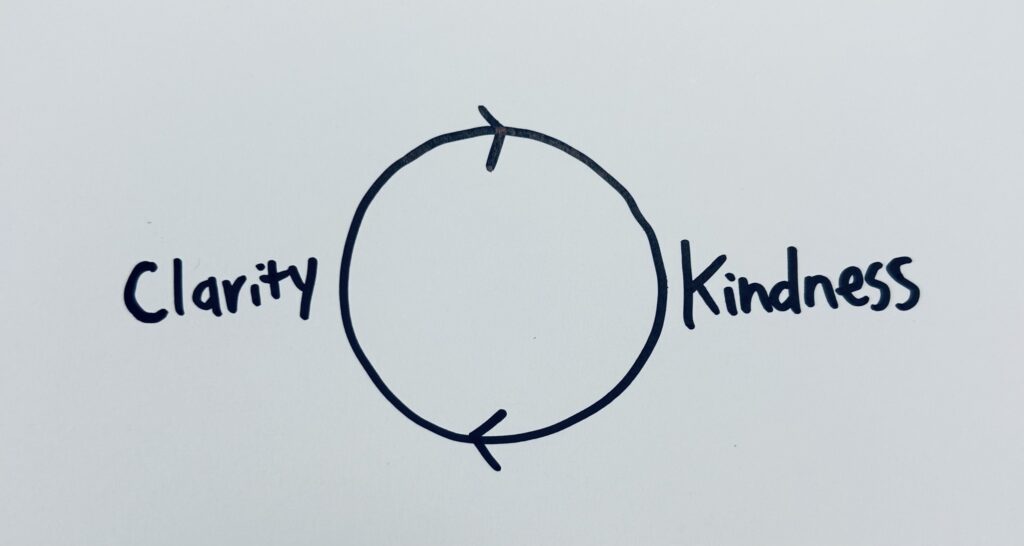
And yet, as Socrates reminded his son, what we see on the surface is rarely the whole truth. We don’t know the full story playing out behind someone’s eyes. Pausing to hold space for that mystery softens us, makes us kinder. That softness is not weakness but wisdom. Clarity.
And clarity and kindness are inseparable.
It’s like that bit of Chinese wisdom: Clarity can be obtained only in a kind person. A person can be kind only with clarity.One helps the other.
One of the most haunting, beautiful stories I’ve ever read about appearance versus reality comes from William March’s masterful novel, Company K—a mosaic of war stories in which each chapter is a different soldier’s account of the front lines.
Private Allan Methot, once an aspiring poet, complained that the “spiritual isolation” of army life was unbearable. He couldn’t talk to anyone. No one could understand him. His fellow soldiers repulsed him—they seemed to care only about food, sleep, alcohol, and women.
As if that weren’t bad enough, he was assigned night watch duty with Private Danny O’Leary—whom he found hopelessly dull.
Methot wrote that O’Leary’s eyes were “unlit by intelligence” and that “he would stand there stupidly and stare at me, his heavy brows drawn together, his thick lips opened like an idiot’s.” Any attempt at conversation was futile. When Methot spoke to O’Leary, “he lowered his eyes, as if ashamed of me, and stared at the duckboards, fumbling at his rifle. . . .” When O’Leary finally spoke, it was to ask Methot when he thought they might get paid.
Methot laughed in contempt. How alone he was! It was as if he lived among aliens. His account ends in despair. He climbed out of the trench and walked slowly toward enemy lines, reciting poems aloud, waiting for the moment when a soldier’s boot would crush his “frail skull.”
And then, in the very next chapter, came Private Danny O’Leary’s letter to Methot.
In it, O’Leary wrote that Methot’s poems were the most beautiful thing he had ever heard. He thanked Methot for his friendship, saying that his faith in him had changed his life.
His letter is so devastatingly beautiful that it’s worth writing in full:
“I would like you so see me now, Allan Methot: I would like you to see what you have created!—For you did create me more completely than the drunken longshoreman from whose loins I once issued.
I was so gross, so stupid; and then you came along—How did you know? How could you look through layer upon layer until you saw the faint spark that was hidden in me? . . . Do you remember the nights on watch together when you recited Shelley and Wordsworth?—Your voice cadencing the words was the most beautiful thing I had ever heard. I wanted to speak to you, to tell you that I understood, to let you know your faith in me would not be wasted, but I dared not.—I could not think of you as a human being like myself, or the other men of the company. . . . I thought of you as someone so much finer than we that I would stand dumb in your presence, wishing that a German would jump into the trench to kill you, so that I might put my body between you and the bullet. . . . I would stand there fumbling my rifle, hoping that you would speak the beautiful lines forever. . . . ‘I will learn to read!’ I thought. ‘When war is over, I will learn to read! . . .’
Where are you now, Allan? I want you to see me.—Your friendship was not wasted; your faith has been justified. . . . Where are you, great heart? . . . Why don’t you answer me?”
Whoa.
As I mentioned, this story really stuck with me. Whenever I talk with someone now—the cashier at the grocery store, a friend, my brother—I try to imagine the boundless intelligence and light behind their eyes. The infinite treasures and possibilities just below the surface.
The paradox is that what’s most mysterious—uncertain, unlabeled, unknown—is often what’s most real. It’s what most closely resembles life itself.
I try to remember that clarity is probably more about what I cannot see than what I can.
And somehow, that simple truth—that I know so little—makes me calmer, kinder, and happier.
Company K by William March I pulled this off my bookshelf at random while looking for the next book to read, and after skimming a few pages, I was sucked in. It’s considered one of the best war books of all time for a reason. Each chapter (and they’re short chapters) is a different soldier’s account of the war. It’s fiction, but I got more insight from this book than from many of the nonfiction books I’ve read this year. It’s seriously so, so good.
Epictetus: The Complete Works by Robin Waterfield I’d been meaning to read this book for a while, and I’m so happy I finally dove in. This newer translation of Enchiridion and Discourses—two works I’ve been obsessed with since first reading them nine years ago—feels like a fresh conversation with an old friend. Epictetus himself never wrote anything down; everything we have comes from the careful notes of one devoted student.
One of my biggest takeaways: A person might be physically stronger than you. Five people could tackle and restrain you. A person may be smarter, healthier, more beautiful than you. But none of that makes them superior to you. The only thing that can make a person superior istheir use of superior reasoning. If you wish to truly improve yourself, Epictetus insisted, improve your reasoning.
Also, he will make you laugh:
“‘So am I the only one who’s going to be decapitated today?’ What are you saying? Would you want everyone to have their heads cut off? Would that make you feel better?”
“Don’t complain. Don’t say, ‘Everyone hates me!’ Who wouldn’t hate someone who carries on like that?”
Oh, Epictetus. Always a pleasure.
Courage Under Fire by James Bond Stockdale I bought this book (it’s more like a pamphlet—only about 21 pages) on vacation last year at The Painted Porch Bookshop. I’m not sure why I pulled it off the shelf this month, but it turned out to pair perfectly with Epictetus: The Complete Works, as Stockdale used Epictetus’s teachings to get through seven and a half years as a POW in Vietnam.
Socrates by Paul Johnson Before Socrates, philosophy belonged to society’s elite—an abstract pursuit reserved for those with leisure and education. Socrates changed that. He brought philosophy down to earth, turning it into something practical, something any person could use in daily life. What is good and what is bad? What’s worth chasing and what’s worth avoiding? How should we define justice? At its heart: What makes a good life? Socrates laid the groundwork on which Stoicism would later be built. It’s no wonder he was Epictetus’s hero.
Discipline Is Destiny by Ryan Holiday I reread this book—well, technically I listened to the audiobook for the first time—on a whim while driving to the Grand Canyon. It’s amazing how much I’d missed the first time through. If you haven’t read Discipline Is Destiny, you’re truly missing out. Also, the afterword is one of the best reflections on the writing process I’ve ever read.
Address Unknown by Kathrine Kressmann Taylor Oh my gosh, this book is absolutely brilliant—and haunting. It’s the ultimate example of “words as weapons.” It’s short, too—you can probably read it in under an hour. By the end you’ll be smiling and thinking holy shit at the protagonist’s brilliance.