Code Breaker: Jennifer Doudna, Gene Editing, and the Future of the Human Race by Walter Isaacson Isaacson takes enormous people and ideas and turns them into swift, gripping narratives. Leonardo da Vinci and Elon Musk were fabulous. Code Breaker was no different. The subject alone—gene editing, curing disease, rewriting the very code of life—is insane, but what makes it such a pleasure to read are the stories behind the science. “The key to true curiosity is pausing to ponder the causes,” Isaacson writes. Why is the sky blue? Why does this molecule behave the way it does? For Jennifer Doudna, the book’s central character, it was not enough to get the answers—she needed to know how the answers could be of use to the world. Her breakthroughs came from a willingness to move into unfamiliar fields, to take intellectual risks, to ask questions that were bigger than she felt qualified to answer. Real discovery, Isaacson suggests, begins not with answers, but with the courage to linger inside a good question. To keep looking.
The Greatest Sentence Ever Written by Walter Isaacson The second sentence of the Declaration of Independence is, Isaacson says, “the greatest sentence ever crafted by human hand.”
We hold these truths to be self-evident, that all men are created equal, that they are endowed by their Creator with certain unalienable Rights, that among these are Life, Liberty and the pursuit of Happiness.
In each chapter of this tiny book, Isaacson pauses over a single phrase or word. What did the founders mean by “self-evident”? What about “unalienable rights”? Where did these ideas come from? What should they mean to us now?
These shouldn’t be abstract questions. The Declaration of Independence was intended to be used in our lives and laws, written not to become a relic of history but to be questioned, returned to, and practiced. You couldn’t ask for a better starting point than this book.
A Man Called Ove by Fredrik Backman My aunt-in-law started a family book club this year, and this book was the first on the list. I probably wouldn’t have read it on my own, so I’m glad it was forced on me. I really enjoyed it. The only thing I wasn’t prepared for was how sad it was: after the first night of reading I had to emotionally detach. (Once detached, I was fine. Mostly.) It reminded me of another fictional character named Babbitt, although Ove is much more endearing. Ove is rigid, rule-bound, and easily irritated. The obvious message is that you can’t judge a book by its cover: the gruff, inflexible exterior conceals a surprisingly tender heart (as depicted in the trailer of the 2022 movie adaptation, A Man Called Otto). But my biggest takeaway was how much time this guy wasted. How opinionated he was about stuff that wasn’t in his control (namely, other people’s behavior). It turned out to be the perfect book to begin the year with. My word for this year is focus. Namely: focus on what I do. Less time forming opinions about what everyone else is doing, and more time paying attention to what I do and what I think about. My own thoughts and actions. Those two things alone will give me more than enough work this year/the rest of my life.
The Johnstown Flood by David McCullough Imagine a dam 72 feet high and nearly 900 feet wide, sitting above a small Pennsylvania town. Imagine it holding back a lake more than two miles long, containing 20 million tons of water. Imagine the lake sitting on one of the most exclusive country clubs in America, owned by powerful, wealthy men such as Andrew Carnegie, Benjamin Ruff, and Henry Clay Frick.
Now imagine the dam breaking.
That’s what happened in 1889, when the South Fork Dam collapsed and sent a wall of water roaring downstream at forty miles an hour, flattening everything in its path. Entire neighborhoods vanished. Trains were lifted from their tracks. Houses, trees, animals, and people were swept together into a single moving mass. By the time the water finally stopped, more than 2,200 people were dead.
McCullough once said he wrote this book because he wanted to read a good account of the tragedy and couldn’t find one, so he decided to write the book he wanted to read. The result is both a gripping historical narrative of the event, and a sobering reminder that the people in charge definitely don’t always know what they’re doing. It’s also a reminder of how even the biggest catastrophe—the biggest anything, really—is eventually forgotten.
Travels with Epicurus: A Journey to a Greek Island in Search of a Fulfilled Life by Daniel Klein The Art of Happiness by Epicurus and The Pocket Epicurean by John Sellars are two of my favorite philosophy books. And now I can add another Epicurean one to the list. Epicurus wasn’t a hedonist, as some people claim. Yes, he said the ultimate goal of life is pleasure. But pleasure from moderation, not excess. By keeping his tastes simple, bread and water were exquisite tasting. The best pleasures, he said, are the tranquil ones, not the wild ones. A clear conscience, good company, and a mind free from mental disturbances. It doesn’t get much better than that, he’d say.
Tales of Soldiers and Civilians by Ambrose Bierce Oh man, this book was FUN. It’s a collection of short stories by the philosopher and cynic Ambrose Bierce. The stories are dark and macabre, and set mostly during the Civil War. Each story has a twist at the end. And yet the stories are philosophical? It’s like guilty pleasure reading without the guilt.
What a beautiful gift—the abilityto read. To be rewarded so vastly for a few hours of your time and attention.
It almost isn’t fair how easy it is! Open a book, let your eyes move over the lines, and bam—the world’s wisdom is yours.
What a beautiful gift a good book is.
The pages… the sentences…
The words.
One after another they chip away at our ignorance—our discontentment—and return us at once to stillness. We breathe a sigh of relief.
The stories.
One after another they pile up, pushing us away from the center of the universe, expanding our world as we’re brought down to size. We’re humbled and empowered. We become fearless.
I read around 70 books this year, and many of them were among the best I’ve ever read. There were some that I couldn’t stop talking or thinking about, so I had to put them in a list and recommend them to you. These are the books that most changed the way I think, taught me something invaluable, and pushed me to be a better person. I have a feeling they’ll do the same for you.
Etty was a Dutch Jew living in Amsterdam when she began her diary—at her therapist’s urging—nine months after the Nazis took over the Netherlands. She was 27 years old. Two years later, at age 29, she would be murdered in Auschwitz, along with her family.
This book is made up of those diary entries and letters. Within them, we witness a startling personal transformation that unfolds over just two years.
In the early pages, we meet a young woman in emotional chaos: boy-crazy, prone to self-indulgent daydreaming, keenly aware that she spends too much time gazing at herself in the mirror. But as time passes, something remarkable happens. She begins to transform—spiritually, emotionally, philosophically—all in the face of unthinkable horror.
It’s as if the bleaker her circumstances became, the stronger her spirit grew.
While stationed with her family at Camp Westerbork, Etty describes walking beside the barbed-wire fences and feeling… joy. She wasn’t delusional. She understood what would likely happen to her. Yet that awareness did not lead her to despair. In fact, the opposite occurred: she fell more deeply in love with life.
And here’s the thing—she could have gone into hiding. She chose not to.
Defying her friends’ pleas, Etty refused to hide from her persecutors. “She didn’t want to desert her parents, but more than that,” Carol Lee Flinders writes, “it just felt morally wrong to her that anyone would concentrate on personal survival who could be reaching out lovingly to others instead.”
Friends even recall failed attempts to “kidnap” Etty and put her into hiding. Convinced she didn’t fully understand the danger she was in, Klaas Smelik—the writer to whom she would later entrust her diaries—once grabbed her in an attempt to pull her to safety. She wriggled free, stepped back, and said, “You don’t understand me.” When he admitted that he didn’t, she replied: “I want to share the destiny of my people.”
In that moment, he knew there was no hope of “rescuing” her. She would not allow it. Besides, she argued, what did it matter if she went—or if someone else did?
And this was a woman who had everything going for her! She had family and friends, a law degree, ambition, curiosity, and a full, vibrant inner life.
Yet she would not run and hide—not when there were so many people right in front of her she could help.
I could go on and on. Whenever someone asks me if I’ve read anything good lately, this is the book I talk about. Do yourself a favor and read it!
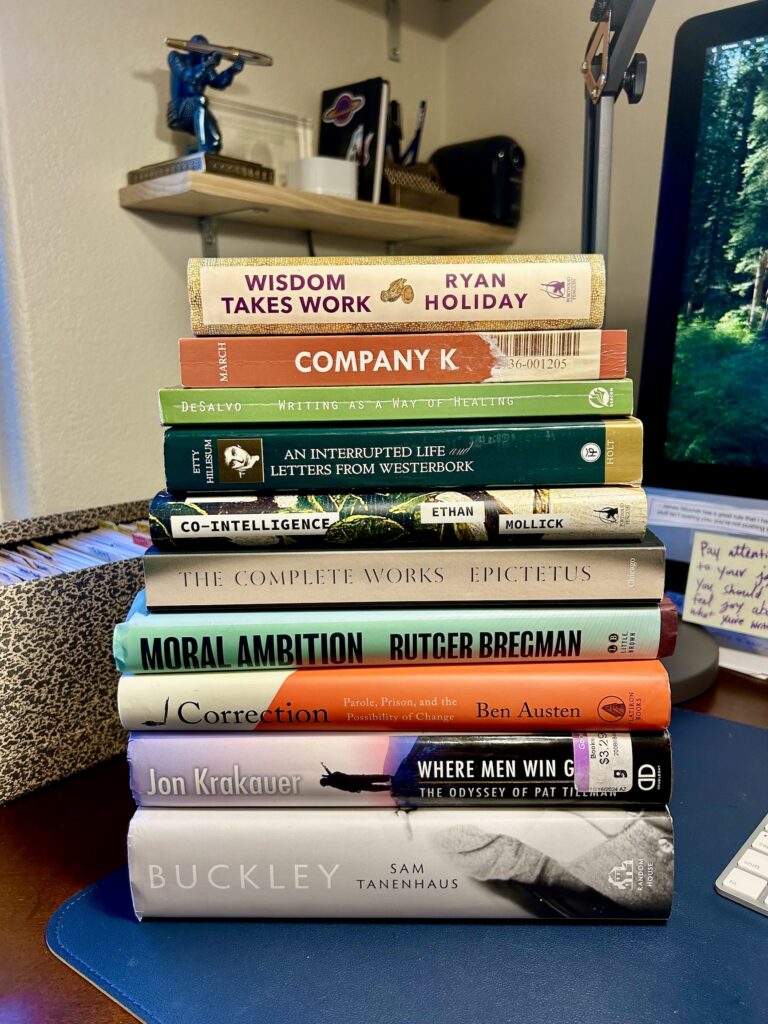
Wisdom Takes Work by Ryan Holiday Not only is this one of the best books I’ve read this year, it’s one of the best books I’ve read, period. It’s also my favorite book in his virtue series.
This book is about the most important kind of knowledge there is: knowing what’s what. What’s worth pursuing. What we should avoid. What we can ignore. What we should never ignore.
Lots of people are smart—but how many have wisdom? Lots of people know facts, but how many can think with nuance? How many people really know themselves? (Self-awareness, he argues, is the rarest thing in the world.)
“Think of the people,” he writes, “who […] miss out on life because they are chasing immortal fame.” They convince themselves that their job is so important they don’t have time for contemplation, or even an hour with a good book. They check their work emails well after they’ve logged off for the day. They do things that could have gone without doing.
“Wisdom is knowing that what you do is important…but that it’s not that important.”
In doing all this, they miss the whole point of life: happiness. Not pleasure or comfort, but the deeper happiness that comes from doing the right thing, for the right reasons, in the right way, at the right time. The happiness that comes from truly knowing what’s what.
And this kind of wisdom takes constant effort. Famed basketball coach George Raveling, Holiday writes, “wakes up each morning, sits on the side of the bed, and gives himself two choices. ‘George,’ he says to himself, ‘you can either be happy or you can be very happy.’”
“Wisdom is happiness. Happiness is wisdom,” Ryan writes. “This is not a tautology. No one would be happy not fulfilling their potential, and yet, can one flourish without joy and happiness?”
This is another book I could go on and on about. It’s that good. Do yourself another favor and read it.
Moral Ambition by Rutger Bregman I didn’t think I would like this book. I assumed it would be another familiar argument about how we should stop chasing money and things and start caring more about making the world better.
And yes—it is that book. But it’s also so much more. It’s genuinely inspiring and eye-opening. Even my wife, Courtney—who typically blasts scream core while she cooks—turned the music off each evening so I could read it out loud until we finished it.
The thought experiment that made philosopher Peter Singer famous goes like this: suppose you’re on a walk and see a child drowning in a pond. You want to jump in and save the child, but then you remember you’re wearing a pair of brand-new, super expensive shoes. Jumping into the pond would ruin them. What do you do?
Obviously, you save the child. Pose this question to anyone and the answer is always the same. What kind of question is that, anyway?
But Singer argues we do the exact opposite all the time. The money we spend on things we don’t need could save so many children’s lives.
One of the stories I loved was that of businessman-turned-philanthropist Rob Mather. After finding the success of a corporate career deeply empty, he wanted to put his energy toward something that actually made a difference. But what? He wasn’t interested in a vague gesture or a symbolic cause—he wanted to take on a problem that was massive, yet solvable. He found malaria.
In 2005, malaria was killing 3,000 children every day. That’s the equivalent of seven jumbo jets full of children going down. It’s almost impossible to fathom. Could one person really do something about that?
As it turns out, malaria has a surprisingly simple and inexpensive solution: mosquito nets treated with insecticide. So Rob decided he would raise money to provide them.
But this raises an obvious question. If curbing such a deadly disease is really that straightforward, why hadn’t someone already done something about it?
That’s one of the many questions Bregman urges us to sit with. Even the tiniest effort on our part, he argues, can make an extraordinary difference. “You can be your average exec in your average company one day and then take the lead in fighting one of the world’s deadliest diseases the next.”
Mather went on to found the Against Malaria Foundation, which has now “raised more than 700 million dollars and distributed over 300 million mosquito nets to 600 million people.” Because of this, the daily death toll has dropped from the equivalent of seven jumbo jets to fewer than three.
In one village in Uganda’s West Nile region—where nearly half the population had suffered from malaria in the preceding months—Rob’s foundation distributed 50,000 mosquito nets. A man from the village later walked six miles to dictate a message through the Red Cross to Rob, letting him know that malaria no longer existed there. The disease had been completely eradicated in his village.
It’s such an inspiring and timely book. Courtney and I loved it.
More books that made this year of reading especially rich:
Buckley: The Life and Revolution that Changed America by Sam Tanenhaus I read this to better understand Charlie Kirk and his motives for saying the things he said. (By the way, this is another benefit of reading good books: so you can hear messages like Charlie’s and not think they’re normal.)
Epictetus: The Complete Works Robin Waterfield Literally incredible. It’s like a cleanser for your mind, washing away the mental weeds and tuning your thoughts to the sound of reason.
Where Men Win Glory by Jon Krakauer I finished this recently and Oh. My. Gosh. It is so, so good.
Narrowing down the above list was tough, so here are other books I read this year and loved:
She starts her novels with something small—an image, a voice, a scene—and lets the structure emerge as she writes.
She wrote two sections of her book Surfacing five years before writing the rest. To know everything in advance, she says, would be “too much like paint-by-numbers.”
Still, many writers, especially early on, try to leap ahead—writing too quickly, aiming for clarity too soon. But that’s a trap. “Rushing through writing is like rushing through life,” Louise DeSalvo has said.
Instead of sprinting to the finish, the best work often comes from moving slowly, clue by clue. “How long are we willing to wait to develop our most singular work?” DeSalvo asks. “Or rather, how long are we willing to work? Are we stopping short of when our work begins to sing its true song? . . . If it took Matisse seven years, or Eugenides nine, why do we expect important work from ourselves in, say, a year or even two?”
She recalls how her early drafts felt “constrained and safe.” Her characters were one-dimensional, the settings vague, the story overly linear. But she kept going. “Dissatisfied though I may be, it’s essential to continue working,” she writes, “for it’s only near the end of the process that I develop my singular voice.” She admits that it isn’t until her eleventh draft that she finally knows what she’s doing with a book.
It doesn’t have to be good right away. Just get started. Let the work simmer. Let it surprise you.
Because if we give ourselves time—if we follow the trail long enough—“we, too, might create a singular, authentic, powerful work of art.”
Well, sometimes that’s exactly the right method
Like Atwood, Thomas Edison didn’t start out with a grand plan.
Edison’s creation of the commercially viable lightbulb was the culmination of small discoveries. He followed those discoveries—trusting they would lead somewhere, even if he didn’t yet know where. As David McCullough often stressed, the people we read about in history had no idea how things would turn out. When we read history, we’re not reading people’s past so much as we’re reading what they were presently living.
In 1878, others were experimenting with incandescent light. “But [Edison],” Ryan Holiday writes, “was the only [person] willing to test six thousand different filaments—including one made from the beard hair of one of his men— inching closer each time to the one that would finally work.”
His success had little to do with intellect and everything to do with persistence.
“Nikola Tesla, who spent a frustrating year in Edison’s lab during the invention of the lightbulb, once sneered that if Edison needed to find a needle in a haystack, he would ‘proceed at once’ to simply ‘examine straw after straw until he found the object of his search.’ Well, sometimes that’s exactly the right method…”
While others despaired, Edison worked. He wouldn’t rush. He would trust the process. And he did it all without the hindsight of knowing how things would turn out.
No one will ask how long it took
George Pocock, the builder behind the world’s finest racing shells, was, as Daniel James Brown writes, “all but born with an oar in his hand.” Boatbuilding ran in his blood—both grandfathers were competitive boatbuilders, and his father built racing shells for Eton College. George carried that legacy forward, blending deep knowledge with an unmatched devotion to craftsmanship. At the peak of his career, he was supplying racing shells to nearly every elite crew program in the country—including the University of Washington, whose team shocked the world with their win at the 1936 Berlin Olympics.
What set his shells apart was the patience and care he put into them. Pocock refused to rush, remembering his father’s words: “No one will ask you how long it took to build; they will only ask who built it.”
A student in a hurry learns the slowest
This is one of my favorite anecdotes in the phenomenal bookWisdom Takes Work:
“There is a story about a samurai warrior named Banzo, who sought an education in a hurry so that he could impress his father. Told by a great teacher that mastery would take ten years, he was aghast.
‘I can’t wait that long. What if I work extra hard?’
‘OK,’ the master said. ‘Thirty years.’
‘But I will do whatever it takes to make it go faster,’ Banzo pleaded.
‘In that case,’ the master said, ‘it shall take seventy years. A student in a hurry learns the slowest.’”