Philosophy

Commit once and for all

About a month ago, a new policy was announced at work.

It wasn’t anything crazy, but I was annoyed, and I complained to Courtney and my parents. The more I thought about it, the more miserable I made myself.

A few weeks later, I was notating Epictetus’s Enchiridion.

“You want to win at the Olympics? So do I—who doesn’t?” Epictetus said to a student. But before you jump in, reflect on what that entails: you’ll need to adopt a strict diet, a brutal exercise regimen, and submit completely to a trainer. Your ankles will likely swell. You’ll sustain injuries and swallow mouthfuls of sand. Oh and after all that you still might lose.

If, after considering everything you’ll have to do, you still want to be an Olympian…then do it wholeheartedly, he said. Don’t pause to think about it or you will end up jumping from one infatuation to the next. You’ll be like a child; one day they want to be a gladiator, the next day a musician, the next an actor, and so on. Give your pursuit sincere attention and commit with all your heart.

He then applies this lesson to life.

You claim to want serenity and freedom and peace, but are you willing to pay the price? Are you willing to change the way you eat and drink? Are you willing to put up with nights of pain? To be criticized? To forfeit status and power? Willing to moderate your desires and aversions? To be okay with getting the small end of the stick in even the tiniest matters? In a word, are you willing to live as a philosopher?

If you’re unwilling, don’t go near it, he says. Walk away. You can’t be a philosopher one day and someone else the next. You can only be one person. Make your decision, and commit once and for all.

This struck me with a force that’s hard to describe.

You say you want freedom, yet here you are, troubled.

Commit once and for all.

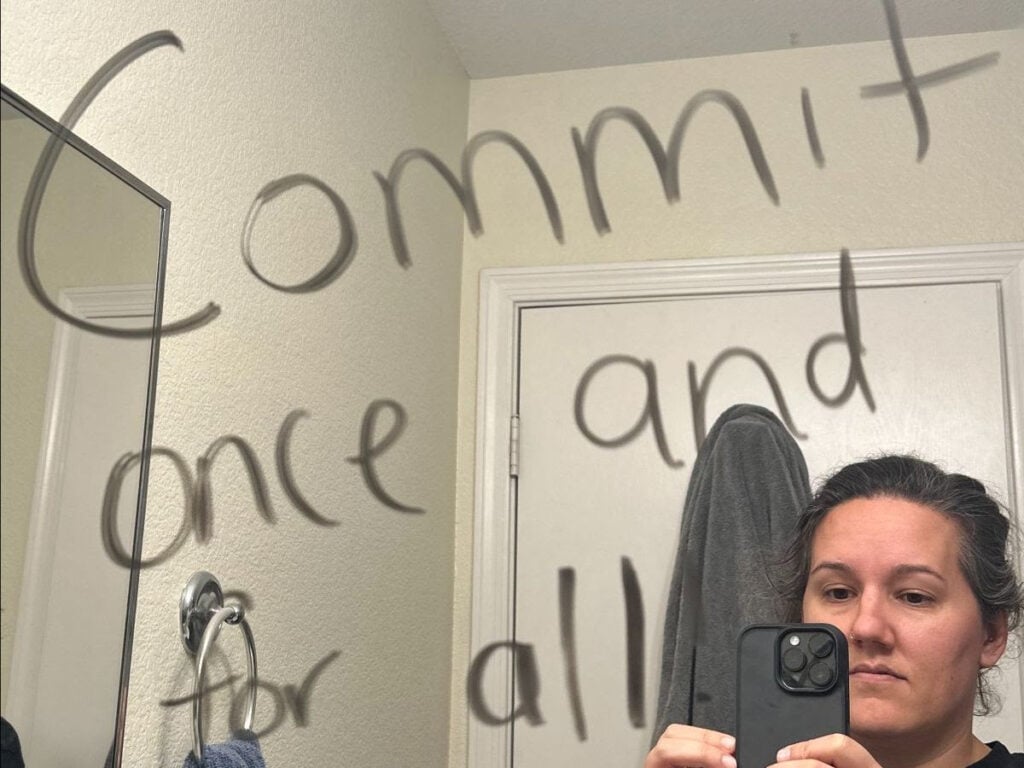
Every day the next week, I wrote, “Commit once and for all” on the back of my hand. I took a thick, black Expo marker and scrawled the phrase on the bathroom mirror. I needed reminders. I had been using philosophy in some parts of my life, but clearly not in others. 

One of my favorite passages from Epictetus is where he says if people truly grasped how short life is, they would never entertain miserable thoughts. He didn’t say they would never entertain a miserable thought unless something seemed unfair, or unless a situation felt overwhelming, or unless someone pissed them off. They just wouldn’t entertain those thoughts, period.

It’s important to note that he wasn’t talking about negative thinking, which we know can be used, paradoxically, to increase positivity. He was talking about thoughts that do nothing but make you feel miserable.

Epictetus spent the first 30 years of his life as a slave. One day, his master, feeling especially cruel, grabbed Epictetus’s leg and began to twist it. “If you keep doing that,” Epictetus told him, “you’re going to snap it.” The master kept twisting. Epictetus’s leg snapped. “See,” Epictetus said calmly. “I told you that would happen.” 

It’s not that Epictetus didn’t feel pain. Of course he did. But his philosophy said things outside of his control could not harm him. That his leg is broken? That is objectively true. That he’s harmed by it? That was up to him. And his commitment to his philosophy was greater than his broken leg. 

Seneca had a respiratory illness that sometimes made it hard to breathe. When it flared, he would spend days in bed, in a state of near suffocation. Writing about these experiences to his friend Lucilius, Seneca said that even though his body was in anguish, his mind was at ease. “Even while suffocating,” he reflected, “I did not stop resting serenely in brave and cheerful thoughts.” The Epicurean philosopher, Epicurus, was in excruciating pain on what he knew would be (and was) his last day on earth. Still, he wrote that he felt a “gladness of mind” by recalling pleasant memories of conversations with friends.

Like Epictetus, Seneca and Epicurus were not immune to pain. In fact, their empathetic natures probably amplified their pain at times. But here they were, nearly suffocating and dying, still committed to their philosophy, still not letting outside things harm them, still feeling “gladness of mind”. Not in a “toxic positivity” way—they weren’t smiling and saying, ‘Aw gee, shucks, isn’t this great?’—but in the contented way that comes from soberly processing negative emotions and calmly accepting what they could not control.

These were people who were committed. This is who they were; the situation wouldn’t change them.

Commit once and for all. This was my wake-up call and a reminder that I can’t pick and choose where I use philosophy. Like an Olympic athlete, I must be totally committed. 

So a policy changed at work? And? Why are you thinking about it now anyway?  It doesn’t take effect until next year. Besides, think of how lucky you are to have this job and the wonderful people you’ve met because of it.

You’ll find a way to use this to your advantage. You’ll see it’s for the best.

P.S. It turns out the new policy won’t change things that much. This brings to mind another stoic principle I had disregarded: don’t suffer before it’s necessary or you’ll suffer more than is necessary. But more on that another time.

P.P.S. Courtney woke up to my mirror reminder. She sent me this pic while I was at work, saying it had scared the shit out of her.

Books Read

-I loved The Devil in the White City by Erik Larson. It’s a story about the Chicago World’s Fair, the architects who built it, and the serial killer who used it to lure his victims. What makes it even creepier is that it’s true.

How To Do the Right Thing by Seneca was great. It’s part of the Ancient Wisdom for Modern Readers series, a collection of books that take individual philosophers’ works and piece together writings on a narrow topic. Other books of theirs I’ve enjoyed: How to Be Free, How to Keep Your Cool, How to Be a Leader,How to Be a Bad Emperor, How to Give, How to Be Content.

-I loved Morgan Housel’s The Psychology of Money, so I preordered and read his newest book Same as Ever, a collection of stories about what doesn’t change. I found some great reminders: the better story wins, risk is what you don’t see, the magic of compounding. Other topics that made me think: the importance of imperfection, the short lifespan of competitive advantage, and the simplicity of most things (and how and why we complicate them).

-I was hesitant to read Elon Musk by Walter Isaacson because I wasn’t sure how transparent it would be. But then I saw that Isaacson referred to Musk as a man-child, and I dove right in. Wow…this is one of the best books I’ve read this year. It’s an up-close view of how one of the most wildly successful entrepreneurs operates and makes decisions. It made me see Musk in a new light. I had a hard time putting it down. A very hard time. The short chapters and loads of pictures made it a fast read too. I didn’t want it to end.

12 more things I learned or found useful in 2023

1. We don’t need more time, we need more focus. We all have the same, fixed amount of time in a day. But with a little mindfulness, we can expand our time. Think about all the things you can do in 15 minutes. You can read a few pages of a book. You can call your mom. You can help your spouse prepare dinner. Now think about all the ways 15 minutes can slip by without notice. Scrolling through newsfeeds, small talk, zoning out in front of the TV. Seneca put it best when he said that time doesn’t slow down to let us know it’s passing by. It’s our responsibility to mind it. We can’t create more time, but we can put the time we do have to good use.

2. The best way to show someone respect is by doing your best.

3. Donald Miller said, “A good movie has memorable scenes and so does a good life.” I’ve been thinking about this lately, especially when I’m out with family and friends. What’s a little extra something we could do to make this more memorable?

4. Don’t let your days become one chore after another. Life requires balance. And space.

5. Setting time limits can relieve stress. For almost a decade, I’ve had the same system for notating the books I read. After I finish a book, I put it in a “to-notate” pile. Later, with notecards and pen in hand, I systematically go back through them and jot down the parts I marked. Recently, I was overwhelmed by the ever-growing stack of books in the “to-notate” pile. This was supposed to be fun, not stressful! So, I decided to impose a time limit. I don’t allow myself to take notes for more than 2 hours a week (or roughly 10-20 minutes per day). Putting this limit on myself made the process fun again and allowed me to enjoy my free time more. Plus, the time limit forces me to write down only the best stuff from each book. Then, on to the next.

6. Getting up early is the key ingredient to living a better life. Ernest Dimnet said, “An hour in the morning is worth two.” I’ve thought about that for years now, and it’s true.

7. I’m always thinking about how short life is. Or rather, I’m highly mindful of how I spend my time. Or, perhaps more precisely, you could say I’m obsessed with weeding out the inessential from my life. (Sometimes to a fault). Why would I accept a promotion if it meant less time with my wife? Why would I allow my schedule to be too packed to see my parents every week and help them when they need it? Why would I spend an hour at the grocery store when I can spend an hour outside playing with my dog and have the groceries delivered?  Why would I go to a gym when I have the equipment at home? I can imagine someone reading this and thinking, gee whiz, just live your life. But to me, this is living my life! Hanging out with my wife, helping my parents, playing with my dog, creating space for spontaneity—that’s the stuff that makes life worth living (and makes me the luckiest person)! That’s how I want to live my life, surrounded by what’s most important. The 2 quotes I read this year that have really shaped my thinking on this:

     Epictetus: “If we keep in mind constantly how short our life is, we will realize there is no room for excess.”

     Seneca: “We don’t have enough time for what’s necessary, let alone what’s unnecessary.”

8. What if we replaced the word envy with admire? We can be quick to shut down thoughts of envy. But, Alain de Botton says, if we take a moment to explore this feeling, we may find what lies beneath is not envy, but admiration. And we usually don’t envy someone’s entire life. Usually, it’s just a part that we envy (admire). And once you’re clear about what you admire, you can work to incorporate it into your own life. Let’s say you envy a successful entrepreneur’s life. You dig a little deeper and realize you don’t actually envy her life—it’s too hectic. What you envy, or admire, is her flexible schedule. Knowing precisely what it is you admire—her autonomy—gives you a clearer vision of what you’d like in your own life. You can then take steps and, say, make a career change to have more flexible work hours. You can repeat this process on multiple people, taking bits and pieces you admire, and fitting them together to create your ideal life.

9. With anything you endeavor to do, the whole point is to have fun. Do the things that you find most interesting.

10. Richard Feynman on happiness: “My rule is when you are unhappy, think about it. But when you’re happy, don’t. Why spoil it? You’re probably happy for some ridiculous reason and you’d just spoil it to know it.”

11. A contented state of being is the most sustainable form of happiness. Epicurus placed pleasure into two categories: active and static. Using food as an example, active pleasure is the pleasure you get from eating. Static pleasure is the pleasure of no longer being hungry. Epicurus believed static pleasure to be superior. When it comes to eating, the ultimate goal is not more pleasure from more food (active), but the contentedness of not being hungry (static). Active pleasures create a desire for more, meaning there’s never enough. Static pleasure is at total peace in and of itself.

12. I’ve been thinking about a quote of Stephen Marche’s every time I want to end my workout early: “Without struggle there is the struggle of no struggle.”

Books Read

-I read Killers of the Flower Moon by David Grann and wow. Wow, wow, wow. In the 1920s, members of the Osage Nation in Oklahoma were mysteriously killed, one by one. It’s a shocking true story of greed and betrayal. I audibly gasped a few times while reading. Like the book Dead Wake (see below), it’s the perfect mix of history and suspenseful storytelling.  

What I Talk About When I Talk About Running by Haruki Murakami. I LOVED this book. It’s a memoir centered on running and how it facilitates his writing. Making a living as a novelist for more than 40 years takes an incredible amount of stamina. Most authors write a novel or 2, then move on to something else; life as a novelist is too hard to sustain. Murakami credits his career longevity to the physical limits he pushes himself to through running. I found the book inspiring and a kick in the ass to push myself harder during my runs.

-After reading The Splendid and the Vile last month, I became an Erik Larson fan. This month I bought and read Dead Wake: The Last Crossing of the Lusitania, and oh my gosh, it was so good. One of the things I love about Larson’s writing is the anecdotes he uses: a person’s frivolous yet telling quirks, the personal struggles of famous men and women, etc. Maybe the best of what he includes is the stuff he personally found most interesting. Like all good writing, his works center on the people, not just the events. On the why behind the what. This book also reads with such slow-building suspense that I had difficulty putting it down.

Be Useful: Seven Tools for Life by Arnold Schwarzenegger. I was skeptical about reading this book, but I’m glad I did. It centers around this idea: be useful. Whatever you’re doing, be useful. If you don’t know what to do next, be useful. Your definition of being useful may be different than someone else’s, but that doesn’t matter. Be useful. Another message I got: you don’t have to always default to paying your dues. Sometimes you have to make a giant leap. (When he was just starting in movies, Arnold didn’t go for little parts here and there, he went for the starring role. In politics, he didn’t run for mayor or city council; he went straight for governorship.) Another message I liked: “Break the mirror”. Know the face of your neighbor better than your own. Focus your attention outward, on helping others. Inward focus is important too, of course, but the underlying reason to become personally successful (a reason I also firmly believe), is not so you can buy a larger house or take more vacations, but so you can do the greatest amount of good for the greatest number of people. This is the best reason for wanting to succeed.

-I loved Haruki Murakami’s book on running and writing so much that I decided to read another book of his, this one on just the writing: Novelist as a Vocation. I loved it. LOVED it. He writes so candidly and honestly that reading him feels like you’re reading a letter from a friend. And it’s filled with wisdom about writing.

Why success is simpler to achieve than you think

A turning point in my life came when I realized that success is not measured by external accomplishments.

Success is measured by my choices.

What did it matter that I was a top performer at work if I was still smoking cigarettes? If I was always stressed out? What was the point of knowing the ins and outs of my industry if I still didn’t know myself? 

We spend so much time thinking about what other people are thinking or doing. We worry about how things are going to turn out. We think we have to do everything right away. Then we wonder why we can’t get anything important done! We wonder why we feel stuck.

Marcus Aurelius said sanity means tying your well-being to your own actions. And being satisfied with even the smallest progress. Circumstances and people can obstruct your path, sure, but nothing can impede your will or disposition. Nothing can stop you from adapting, from using obstacles as fuel. “As a fire overwhelms what would have quenched a lamp,” Marcus said. “What’s thrown on top of the conflagration is absorbed, consumed by it—and makes it burn still higher.”

It was this realization—the realization that no one could hinder me, that no obstacle could keep me from taking the next most appropriate step in my life—that gave me clarity. I went back to school in my late twenties. No one could stop me from taking one class, and then the next. I got my degree in half the time. I quit smoking.

When I started focusing on my own actions, and taking it one step at a time, that’s when things changed.

Internal Focus = Freedom
In 1981, the young physicist Leonard Mlodinow accepted a postdoctoral fellowship at Caltech University. On his first day, the physics department chairman pulled Mlodinow into his office. “We have judged you to be the best of the best,” the chairman said to him. Because of this, Mlodinow could work on whatever he’d like. He could teach. Or not teach. He could design sailboats. It didn’t matter. Whatever he chose to work on, the chairman said, was bound to be important. Mlodinow was much less confident. He felt tremendous pressure. What should he do? What was important to him? String theory was popular, should he devote himself to that? He liked to write, should he be a writer? Frustrated, he sought advice from the famous Nobel Prize-winning physicist Richard Feynman, who worked down the hall. As the academic year progressed, Feynman offered Mlodinow advice and challenged his thinking. Still, he was lost. People were depending on him to do great things! And he had no idea where to start. After about a year of working alongside Feynman, Mlodinow began to understand why he had been having so much trouble finding a direction: his focus was external. “I had gone through college and into academia in a hurry,” he said, “wanting to rush ahead with my work, to prove to the world that I had been alive, and that it had mattered.” He had been stuck, he said, because he thought worthy goals were meant to “accomplish and impress”, and that he needed to be considered as “an important person, and a leader.” But Feynman’s example showed him a different way. Feynman “didn’t seek the leadership role. He didn’t gravitate to the sexy [popular] theories. For him, satisfaction in discovery was there even if what you discover was already known by others. It was there even if all you are doing is re-deriving someone else’s result your own way. . . . It was self-satisfaction. Feynman’s focus was internal, and his internal focus gave him freedom.” Mlodinow realized that he didn’t need to live up to other people’s expectations. He may not achieve the conventional or material success that his parents had wanted for him, but (and here we can imagine him smiling as he wrote), “at least with an internal focus, my happiness would be under my own control.”

What You Get is Gradual Transition
Author and comedian Mark Schiff recalled a conversation he’d had with an old rabbi. The rabbi had spent most of his life studying the Talmud for hours and hours each day. “What bothers me most,” the rabbi said, “is that with all the studying I’ve done, I feel like I’ve only dipped the tip of my pinky into the well.” And that’s what it feels like sometimes, doesn’t it? We put in years of hard work and it feels like we’re standing in place. But of course, this is an illusion. We are making progress—it’s just hard to see against the backdrop of our infinite potential. Schiff points out that no one reaches his or her full potential. Why? Because our potential is so vast! The rabbi concluded, “I’ll just have to be satisfied [that] I’ve done the best I could do.” And that’s all any of us can do. There’s no perfection, no ultimate becoming. There’s just a continuous journey. Donald Miller pointed out how some people become depressed when they realize this. Unlike the movies, there’s no one grand climax in the script of our lives. There are climaxes in the subscripts—milestones hit, goals achieved—but there’s no one climax. The human journey goes on. In Aaron Thier’s novel The World is a Narrow Bridge, the characters go on a cross-country trip. They cross the Mississippi River and enter the beautiful, magnificent American West. “And yet,” Ryan Holiday observes, “everything seems the same. The same trees, the same scenery, the same air.” The human journey goes on. As Thier writes, “You wait for the big moment, and what you get is gradual transition.”

Internal Focus. One step at a time. Gradual transition. That’s success.

Books Read

The Monster of Florence by Douglas Preston and Mario Spezi was wild…and disturbing. Basically, American journalist Douglas Preston and Italian journalist Mario Spezi decided to write a book about the never-identified serial killer who stalked and murdered young lovers between 1968 and 1985 in Florence, Italy. What makes the story even more unsettling is the web of corruption within the investigation—a web Preston and Spezi became caught in themselves.

-Each year, I reread Meditations by Marcus Aurelius, and I always find new takeaways. I ALWAYS feel lighter and happier afterward. The context of Meditations has been well-documented, but I’m compelled to reiterate it here because it’s the context that makes it so remarkable. Marcus Aurelius never intended for Meditations to be read by anyone—it was his private journal, full of admonishments, encouragements, and reminders he’d written to himself about how to live a good life, develop his character, and be of service to others. And here’s the thing: he was the most powerful man in the world. He could have done whatever he wanted! He could have indulged every desire and lived in comfort and luxury. Instead, his thoughts and actions were focused on doing the right thing and helping other people. He was the exception to the rule that “absolute power corrupts absolutely”. Named the last of the “Five Good Emperors”, Marcus Aurelius wrote Meditations 2,000 years ago, and it is still one of the most inspiring texts we have today on how to live a good, happy life.

-After reading The Consolations of Philosophy in May, I had been looking for more books by Alain de Botton. I searched his name on Amazon and found a book series he edits, The School of Life, and I bought and read How to Think More Effectively. I got so much from it. It’s made up of fifteen short chapters, each about a different way of thinking. I’m eager to go back through the book and notate the passages I marked and underlined. I also bought and look forward to reading The School of Life: An Emotional Education.

-From another book series I love, I bought and read How to Be a Stoic, a great little book with a few chapters from each of the 3 best books on Stoicism: Enchiridion, On the Shortness of Life, and Meditations.

-I bought The Splendid and the Vile: A Saga of Churchill, Family, and Defiance During the Blitz by Erik Larson over a year ago and finally got to reading it. And it’s as good as people say it is. The absolute best thing that I got from this book though was in the Sources and Acknowledgments section at the end. Larson tells us why he decided to add another book about Winston Churchill to the public collection, and how he made it different from all the rest.

Scroll to Top