Why I’m still writing Morning Pages 12 years later
People are often surprised when I tell them I write three pages in my journal each morning.
“How do you have that much to say?” they ask.
I tell them it’s not really about having something to say. I just write down what I’m thinking—what I’m excited about, what I have to do that day, how good a brownie sounds. If I have nothing to write, I write I have nothing to write until something else comes out.
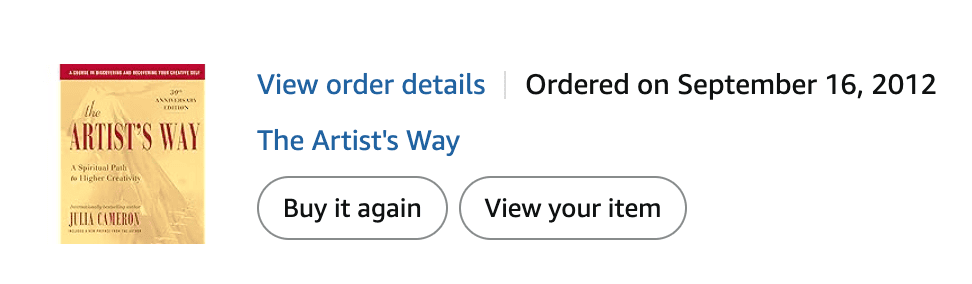
It’s what Julia Cameron coined as Morning Pages—three pages of longhand, stream-of-consciousness writing done first thing in the morning.I first read about Morning Pages in Julia Cameron’s The Artist’s Way, which I bought in 2012.
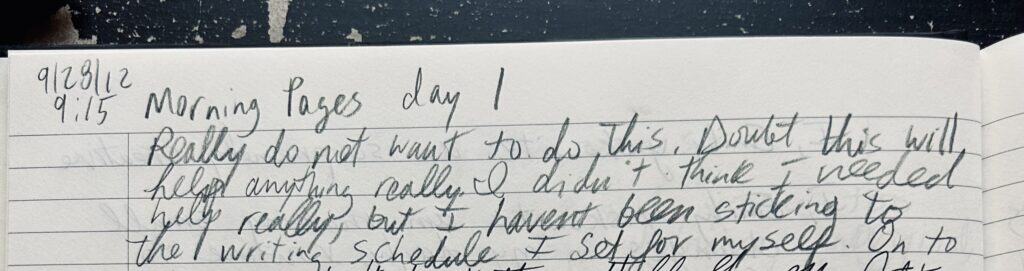
I was skeptical. My first entry reads, “Really do not want to do this. Doubt this will help anything really. I didn’t think I needed help really, but I haven’t been sticking to the writing schedule I set for myself.”
For the next five years, I wrote Morning Pages on and off before finally sticking with them for good.
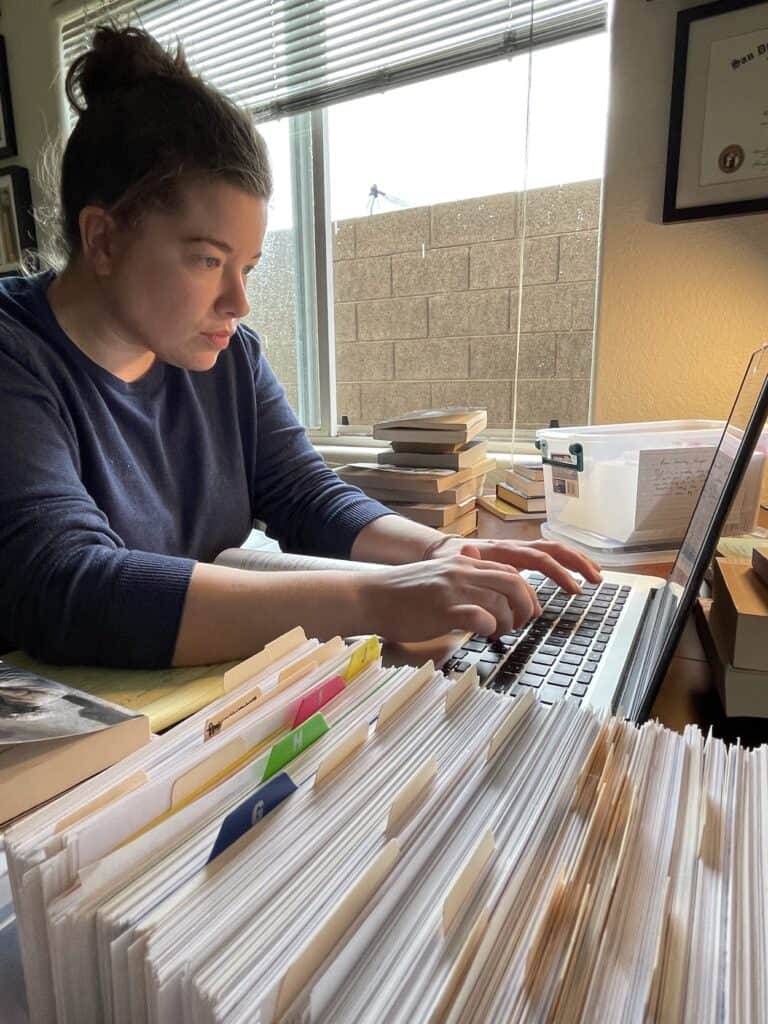
This month, I pulled out the Sterilite storage bins full of old Morning Pages and read through some. And I noticed something curious. Something about the dates.
On September 28, 2012, the same day I started writing Morning Pages, I broke up with my then-boyfriend—something I had been putting off for months.
On August 20, 2013, after not writing Pages for a few months, I picked them up again. Two days later, I slid into my future wife’s DMs. A few months after that, I finally moved out of my parents’ house.
Between 2014 and 2016, I didn’t write a single Page. Those years were marked by one crappy call center job after another.
Then, in early 2017, I started writing Pages again. Not long after, I enrolled in community college. I graduated in 2019. I kept writing. In 2020, I landed the job I have today, one I love.
Until this month, I hadn’t realized it: almost every pivotal shift in my life has coincided with the periods I was writing Morning Pages.
It’s no wonder Julia Cameron calls Morning Pages her lifeline. “I would no more do without them than I would try not breathing,” she says. The list of people who swear by them includes Olivia Rodrigo, Tim Ferriss, Billy Oppenheimer, and Elizabeth Gilbert, who said without Morning Pages, “there would be no Eat, Pray, Love.”
I started writing Pages to unlock creative blocks. I didn’t expect them to quietly shape my life.
You could call it a coincidence—I would’ve made those choices anyway. I’m not so sure. The pattern’s too strong to ignore.
But even if the timing was a coincidence, the benefits I get from writing them are not.
If you’re wondering what Morning Pages actually help with, here’s my answer—after 12+ years of writing them, I can confidently say they’ll help you…
Clear the mental fog
Morning Pages aren’t quite the same as journaling. With journaling, you usually have a topic or theme or something you’re trying to figure out. With Morning Pages, you write whatever’s in your head—no structure, no filter. You dump the junk drawer in your mind so you can get on with your day.
Tim Ferriss, author of The 4-Hour Work Week, said, “Morning pages don’t need to solve your problems. They simply need to get them out of your head, where they’ll otherwise bounce around all day like a bullet ricocheting inside your skull”.
By the time you’re done, your head is clear. No more mental pit stops throughout the day to decide what to do next. You already know.
Take action
Morning Pages surface unresolved problems until you deal with them. They don’t let up. They circle back, repeating the same thoughts, wearing you down until you finally take action.
For instance, this month, I wanted to pinpoint the epiphany I had in my 2017 Pages about going back to school. I scanned page after page looking for the tell-tale signs of a dramatic turning point—exclamation marks, all caps, maybe some lightning bolt doodles.
Instead, I found: “I guess I’ll get my stupid degree.”
Wait, what?? I guess I’ll get my stupid degree???
I don’t remember being so annoyed and reluctant. But apparently I was. But that’s the thing: sometimes doing the right thing feels like surrender.
Anyway, that’s what Pages do—they compel you to take action if for no other reason than they won’t shut up about it until you do.
Change perspective
I read a recent article by an author who said writing Morning Pages made her miserable. She would spend day after day writing about how sad she was, which only made her feel worse.
Of course, everyone’s experience is different. But for me, it’s been the exact opposite. If I’m sad or anxious, writing it down helps shift my perspective, which is often healing in itself.
When blink-182’s bassist Mark Hoppus was diagnosed with stage 4a lymphoma in 2021, his therapist suggested he keep a journal throughout chemo to help with his anxiety and depression. “Write down whatever you’re feeling, stream of thought. Write like no one’s ever gonna read it.”
His first entry, on May 11th, was raw and brutal. Confused. Angry. Hopeless. “Good fucking times,” he wrote after describing the first few rounds of chemo. He wonders if he would be better off dead.
A few weeks later, he writes, “You’re a real fighter? Holy shit. You’re just too afraid to do the right thing and die.”
But then, in the very next line, he admonishes himself. “No. Don’t do that. Think positive. . . . Is this therapeutic? Is this helping? Writing down all my thoughts? My hair is falling out and I’m throwing it into the fire.”
By June, though still struggling, his tone had shifted. He started listing things he was grateful for. “You’re the luckiest person on the planet,” he wrote. And later: “I have so many kind and caring friends. Good people. I’m blessed.”
Pay attention to your life
Even on days when I have nothing to say, when the only words rolling off the nib of my pen are the lowest-hanging fruits of thought and the shallowest observations, I’m still benefiting. I’m still noticing things about myself. I’m still clearing my mind for a calmer start to the day, still spending time with my thoughts.
In short, I’m paying attention to my life. I’m engaged and active. I happen to life, not the other way around.
I’ve noticed that when I’m paying attention to my life, that’s when I’m happiest.
Pay attention to your feelings
Negative emotions don’t have to disappear for you to feel better. Sometimes all it takes to loosen the grip of a feeling is to simply name it. Trace its outline. Examine its contours.
“What we call depression,” Alain de Botton said, “is in fact sadness and anger that have for too long not been paid the attention they deserve.”
Go your own way
One reason Pages are written first thing is that your ego hasn’t fully woken up yet. In those early hours, you’re less guarded. More honest.
As Julia Cameron said, when we’re honest with ourselves, we’re more honest with others. We learn to draw firmer boundaries. We speak more clearly. We trust our instincts.
We follow our own path in life because we’ve already practiced following it on the page.
Keep the important stuff in the forefront
Epictetus said our predicament is that time and again, we lose sight of what’s important.
The truth never changes. Wisdom is always the same. Our brains are just exceptionally good at forgetting.
Writing each morning helps keep the important things front and center.
Rewrite your software
If we don’t monitor our thoughts, we become vulnerable to their influence and control. We can end up living in the worst way: unconsciously.
Lusting for money, worshiping material things, seeking power, thinking you’re the center of the universe…what’s insidious about these things “is not that they’re evil or sinful,” writes David Foster Wallace, “it is that they are unconscious.”
Morning Pages make us more conscious of our lives. It’s a spiritual process, and as Sadhguru put it, “A spiritual process means we have made up our minds to rewrite our software, consciously.”
Hear the wisdom within
Your subconscious is wise. The problem is that it’s terribly quiet and shy. It often won’t respond to direct questioning.
That’s where Pages come in.
Morning Pages create a regular, quiet, purpose-free space for your subconscious thoughts to roam freely. Only then, in familiar solitude with you, do they feel comfortable speaking up. And when they do, watch out—they’re assertive.
Create space between self and mind
The Buddha became enlightened when he stopped identifying with his personality and became a witness to his intellect.
The essence of yoga and meditation is to arrive at the space between yourself and your mind. In this space, you’re free from limitations. Your sense of clarity and perspective is heightened, along with your freedom.
We can access this state each morning in our Pages.
See what’s in your head
Write down “the contents of the noise in your head,” Verlyn Klinkenborg says. “You can’t revise or discard what you don’t consciously recognize.”
By dumping our thoughts and feelings onto the page, we’re able to sift through, untangle, and examine them. And discard the ones that no longer serve us.
Connect to your superpower
Epictetus said we differ from animals and plants in two ways: we can reason and reflect—two things animals and plants don’t need because they were made to obey, not command.
Our ability to look inward is our superpower.
“It is impossible to write Morning Pages for any extended period of time without coming into contact with an unexpected inner power,” Andrew M. Barry says, quoting Julia Cameron. “Anyone who faithfully writes Morning Pages will be led to a connection with a source of wisdom within.”
Animals can look only outward and dream. Humans can look inward and, as Carl Jung said, awaken.
Invest in yourself
Years ago, I read an article by an author who said Morning Pages were a waste of time. She had pages and pages of writing, she complained, but nothing publishable. I remember feeling the same way about my Morning Pages. I could be producing actual content in the real world. I could be getting things done. Yet, here I am, hunched over my journal writing gibberish.
But I was missing the point.
I don’t write Pages to “be productive”. I write them to calm and prepare myself for the day (ironically making me more productive throughout).
I think of what Leo Tolstoy said: “If you can see all of the consequences of your actions, then your actions are of no consequence. All great things are happening in slow and inconspicuous ways.”
I remind myself that even if it doesn’t feel like it, the small moments I spend writing—working on myself—are adding up in unfathomable ways.
Whenever I feel an urge to stop short of my three pages and do something more “urgent” or “important”, I say to myself, I will get to that thing in just a bit. Right now, this is what’s most important.
It might be the most important thing you do all day.
By the way, here are some tips to get you Paging like a pro:
-Wake up about 30 minutes earlier to give yourself time to write.
-Julia Cameron recommends using 8 x 11–inch notebooks. (I’m currently using a 5.75 x 8.25 journal, so I write 5-6 pages—roughly the same amount of space as three larger pages.) (Also: These are great pens.)
-Stop at three pages. Why? You don’t want to slip into overthinking. The whole point of Morning Pages is to get you to take action.
-Write them quickly—but not so quickly that you can’t read your own handwriting.
-It’s not six pages. Not front and back of three. It’s three sides: one full page, the back of that page, and one more.
-You can eat breakfast first. At least, I do. Then I drink my coffee as I write.
-You can skip weekends. Again, at least I do.
-You don’t have to reread them. In fact, it’s probably better if you don’t.
-They’re private. If you live with…curious people, find a way to lock up your journal or bring it with you during the day. You won’t get the most out of them if you’re not being honest.