22 takeaways so far this year

Last week, my wife Courtney and I flew to Austin, TX. We then drove 30 miles southeast to the small town of Bastrop to visit The Painted Porch bookstore, where we met my favorite author and mentor, Ryan Holiday. (More on that next month!)
Back in Austin, we visited the LBJ Library, the Neill-Cochran House Museum, and the State Capital. We took walks around Lady Bird Lake. Everywhere we went, I found a sticker or pamphlet or business card to tape into my journal (which has started to double as a scrapbook.) As I added entries, I looked at earlier ones from this year—the ideas and insights and things learned and magazine clippings and doodles. I found some good stuff to share, things that have changed me and made me better. Things that I think you can use too.
1. Henry David Thoreau said if you think too many trivial thoughts, your brain becomes a mess of trivialities. I couldn’t stop thinking about that. A mess of trivialities.
This led me to think about the people I most admire, and what their thoughts probably look like. They probably don’t think much about personal irritations, or superstitions, or desires, or things that don’t matter. (If they did, they wouldn’t be able to accomplish what they do.) Their thoughts are likely big-picture and worldly. So I made an image in my journal as a reminder to keep my attention on better and higher things.
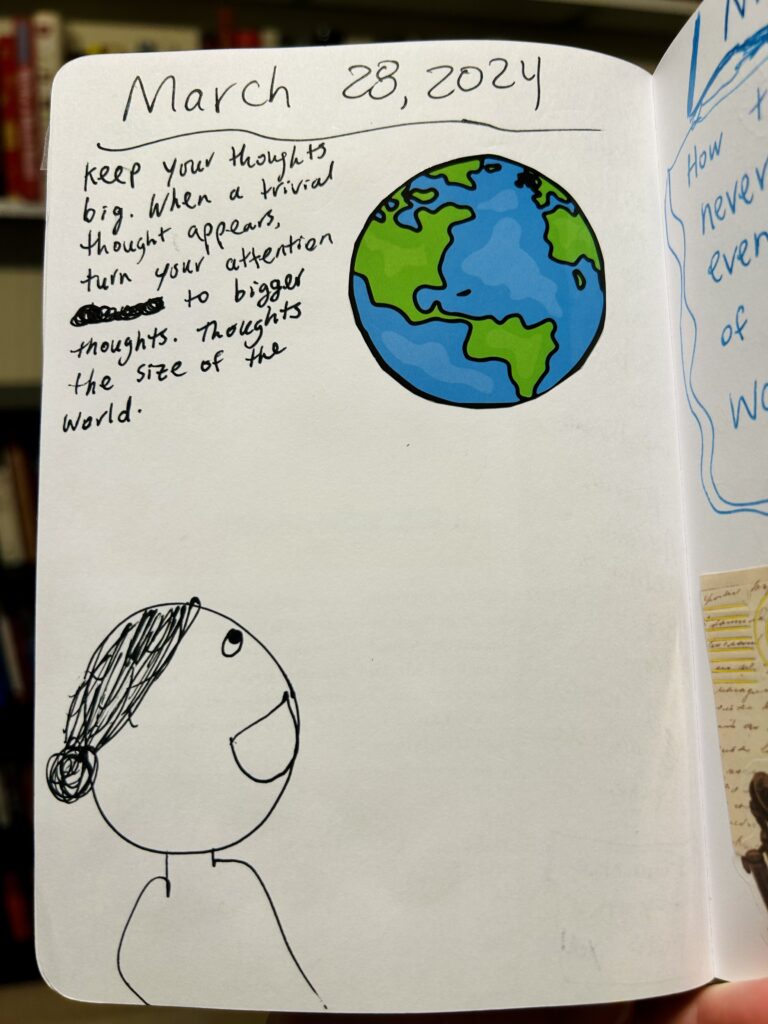
Whenever I have a trivial or obsessive thought—I wonder what he meant by that. Should I redo my hair?—I remember this image of the girl smiling as she focuses on bigger things, and I immediately forget whatever unimportant thing I was thinking about.
The point isn’t necessarily to elevate my thoughts, but to take my mind off the insignificant ones. Which, with time, might become the same thing.
2. In Lynda Barry’s What It Is (one of my favorite books about writing!) there’s a short comic strip of a writer deep in thought, trying to figure out what she should write a book about. Ten years later, someone asks what her book will be about. “Shh! I’m still thinking,” she replies.
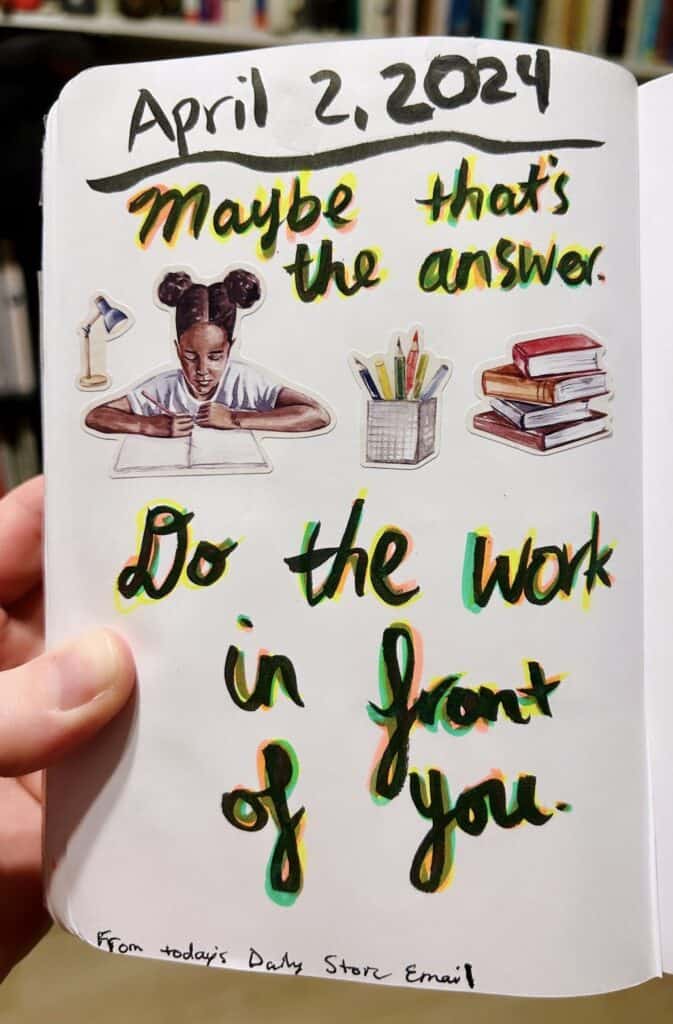
We can’t think our way to good ideas. We have to roll up our sleeves. We have to do the work in front of us.
3. When you look back on your life, what you accomplished will mean far less to you than what you contributed.
4. Make time each day for your own work, and wear yourself out doing it.
Marcus Aurelius asks, “Why aren’t you running to do what your nature demands?” Why aren’t you running to do your work? Not to a 9 to 5, but to the work you’re naturally inclined to do?
Seneca said that only fools begin to live life just as it’s coming to an end. You can’t wait until you’re retired. You can’t wait until you feel like you’ve saved enough money or have fewer obligations. That’s never going to happen.
And isn’t that great news? We don’t have to wait to start living because there’s nothing to wait for!
We will never have the time, so we have to make it. I don’t have the luxury to read and write all day—I’m not sure anyone does—so I wake up a few hours early and do it in the morning. Then I do more during lunch. I look for opportunities throughout the day, too. When coworkers take a smoke break, I take a note break.
Because we can’t wait 10 years. We can’t wait 10 days. Our work must be done now, wherever we are. Because if we wait, we may never get the chance to do it at all. Besides, if you have excuses today, you’ll have excuses tomorrow, too.
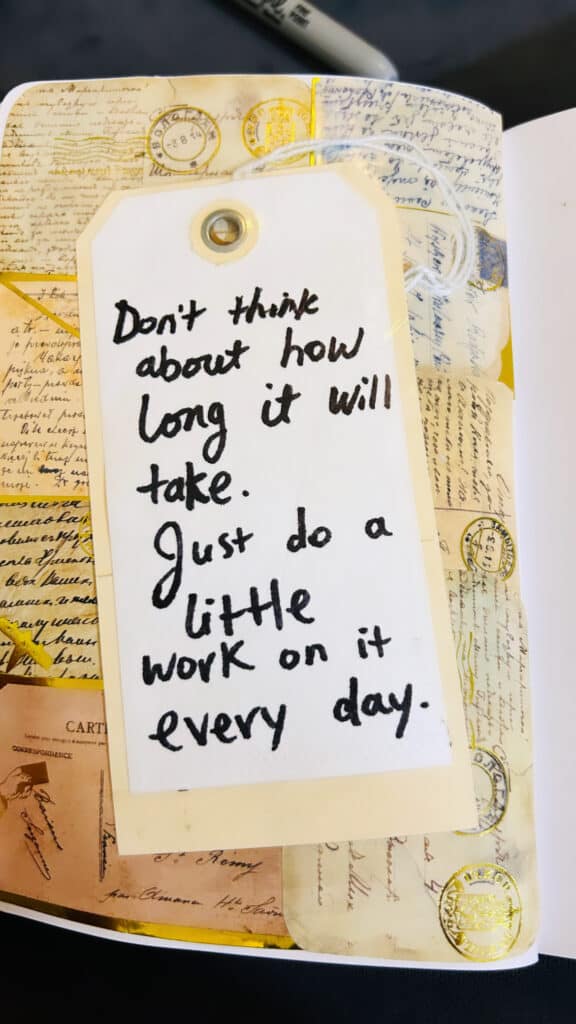
5. Don’t think about how long it’s going to take. Just focus on doing a little work on it each day.
6. The best way to serve the world is to serve your work. And the best work is the work that connects the divine with the human.
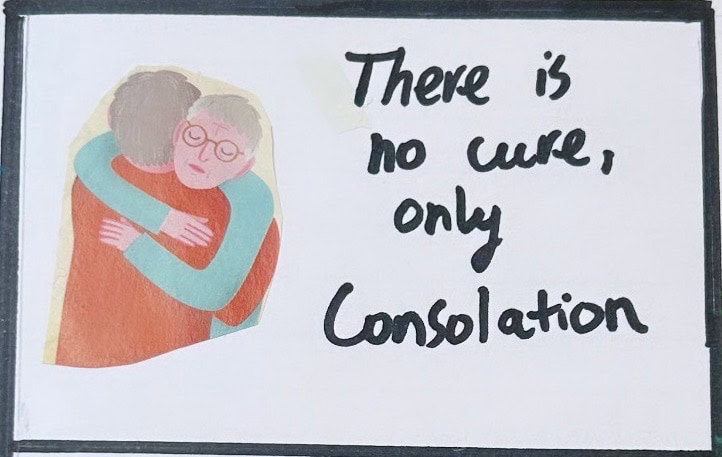
7. In An Emotional Education, Alain de Botton says we’re unhappy because we think perfection is possible. But it’s not. The human condition is struggle and pain and weakness. There’s no cure, only consolation. He puts this idea beautifully:
“What we can aim for, at best, is consolation—a word tellingly lacking in glamor. To believe in consolation means giving up on cures; it means accepting that life is a hospice rather than a hospital, but one we’d like to render as comfortable, as interesting, and as kind as possible.”
8. A common reason for failed relationships is that one person, consciously or not, wants their partner to have only strengths. But, of course, no one has only strengths. Said differently, weakness-free people don’t exist. We’re all flawed. In fact, Alain de Botton pointed out, our “weaknesses” exist because of our strengths. The creative energy that makes her artistic may also lend to her messiness. The guy who can be frustratingly stubborn is also honest and loyal.
9. Despite what Shark Tank would have you believe, you don’t have to have millions of dollars worth of sales or be super well-known. You can sustain yourself and your work with 1,000 true fans.
10. Nature doesn’t ask questions. It just does what it does.
11. In Novelist as a Vocation(another one of my favorite books about writing!) Haruki Murakami said the best way to express yourself as freely as possible is not to ask, “What am I seeking?” (which causes you to ponder heavy things and slows you up), but to instead ask, “Who would I be if I weren’t seeking anything?”
12. Start the clock. Ryan Holiday recently wrote about having a sense of urgency. About the importance of starting the clock on a project, getting the ball rolling as soon as possible. And about spotting bottlenecks quickly and fixing them quickly.
13. I found this gem in a poem of Ray Bradbury’s: “There’s no rest, there is only journeying to be yourself.”
14. We can’t always be calm. But we can make an effort to be more calm than we were last year.
15. The difference between genre and style. Genre is a category. Style is the life and humanity you give the art. As Jerry Saltz put it, “Dolly Parton’s ‘Jolene’ is a classic country song; the vulnerability of her performance is what makes you die inside when you hear it.”
16. The better story wins.
17. When the problem is abstract, ask how. When the problem is concrete, ask why.
18. Relax. You can’t read every book.
19. Don’t be satisfied with doing work that gets you by. Find work to be invested in.
20. Don’t live a boring life.
21. Burn with the ambition to be useful.
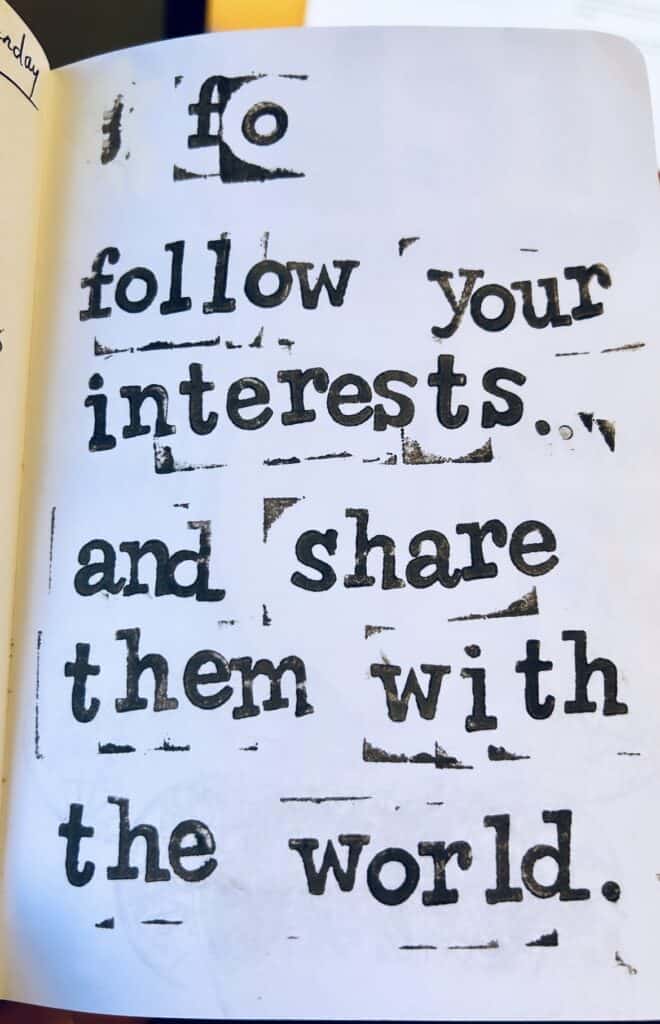
22. A great way to live: follow your interests and share them with the world.
Books Read This Month:
I added all 4 of the books I read this month to my favorites list. If you’re wondering why so many of the books I read I end up loving, it’s because I quit a lot of books I’m not loving. This section could also be called Books I Didn’t Quit This Month:
-I got so, so much from A Life in Parts by Bryan Cranston (and not just because he’s my favorite actor). His career is the epitome of serving the work. Of doing his job. Of changing things up. I’ve heard of golden handcuffs (staying at a job that pays well but makes you miserable), but never velvet handcuffs (staying at a job because it’s comfortable and you’re “learning a lot”.) In a way, velvet handcuffs are more insidious than golden ones. The velvet is comforting, easily missed. In his mid-twenties, Bryan Cranston’s dreams came true when he landed a recurring role on the soap opera Loving. He we finally a working actor. He no longer needed a day job. He was making enough to live on and enjoying the work. About a year and a half into his role on Loving, his contract renewal was coming up. His manager Leonard Grant called him and asked what he wanted to do. “I like having a job,” Cranston answered. “I’m enjoying myself. Learning a lot.” His manager replied, “It’s velvet handcuffs. You’ve got to get out of daytime, or else you’ll wake up and it’s twenty years later and it’s all you’ve ever done.” Cranston realized Grant was right and immediately put in his two weeks.
–Tunnel 29 by Helena Merriman. Wow…this is easily one of the best books I’ve read. It’s the incredible true story of how 29 people escaped through an underground tunnel beneath the Berlin Wall. There are tons of holy shit moments. I learned a ton of history and was never bored—two things I rarely put in the same sentence. Seriously, this book was so much fun to read.
–Leisure: The Basis of Culture by Josef Pieper. I LOVED this book. He talks about the importance of leisure, and how nothing of genius is accomplished without it. He says leisure is a form of silence where “the soul’s power to ‘answer’ to the reality of the world is left undisturbed. For leisure is a receptive attitude of mind, a contemplative attitude, and . . . the capacity for steeping oneself in the whole of creation.” Leisure isn’t about turning our brains off; leisure is about being fully alert and receptive! True leisure is impossible if we’re overworked. Further, overwork creates the dangerous illusion that we’re living a fulfilled life.
–Furious Hours by Casey Cep is another incredible true story. The first half of the book is about a reverend who murdered family members for insurance money…only to be shot dead at one of his victim’s funerals by a grieving relative. The second half is about one of the most famous authors of the time, Harper Lee (To Kill a Mockingbird), and her attempt to tell the story of the reverend. (She hoped it would be another In Cold Blood, the true-crime classic she helped Truman Capote write.) She spent about 10 years—the first few researching, the remaining trying to figure out how to tell the story—before abandoning the project entirely. There’s much speculation about why she never wrote another book after her wildly successful Mockingbird (not counting Go Set a Watchman, which was really just the first draft of Mockingbird). Maybe she thought she would never top her first book. Maybe perfectionism got the best of her. Whatever the case, she might have saved herself years had she decided how to tell the story—or move on to something else entirely—before researching. Perhaps she would have benefitted from Steven Pressfield’s advice in The Daily Pressfield, given to him by Randall Wallace, the writer of Braveheart: “The most important thing is the story. Get that first. What’s the drama about? Who’s the hero? Who’s the villain? How does it end? Once you get those, you can go back and fill in the research.”