Just that you help others with your weird little thing

One of my favorite reads this year has been Oliver Burkeman’s Four Thousand Weeks. And I’ve thought a lot about this passage:

“The only definitive measure of what it means to have used your weeks well: Not how many people you helped, or how much you got done; but that working within the limits of your moment in history, and your finite time and talents, you actually got to doing—and made life more luminous for the rest of us by doing—whatever magnificent task or weird little thing it was that you came here for.”

Isn’t that beautiful? For some reason, it reminded me of a couple of stories in Shoe Dog, another book I love.

Jeff Johnson’s Thing

Before Nike founder Phil Knight hired Jeff Johnson as Nike’s first full-time employee, Johnson worked as a social worker for Los Angeles County. On the weekends he sold Tigers—the Japanese running shoe made by Onitsuka. Johnson loved running and had a romantic view of it. It was almost like a religion to him. He believed that, done right, runners could run themselves into a spiritual, meditative state. One day in April 1965, his supervisor said that he didn’t think Johnson cared about his job as a county social worker. Johnson realized he was right—he didn’t care. So he quit. That day he realized his destiny—and it wasn’t social work. His destiny was to help runners reach their nirvana. “He wasn’t put here on this earth to fix people’s problems,” said Knight. “He preferred to focus on their feet.”

Belief

Before founding Nike, Knight was a salesman—a terrible one. Selling encyclopedias door to door had been a bust. He was only slightly more successful selling mutual funds. He resigned himself to the idea that he just wasn’t a salesman. But when Knight, a lifelong runner, received his first big delivery of Tigers (he had worked out a deal with Onitsuka who was seeking expansion in America), things changed. With a trunk full of Tigers, he drove around to different track events and showed them off to players, coaches, and spectators. He couldn’t write orders fast enough. 

He wondered why he was able to sell shoes but not encyclopedias. Was the difference in his selling ability really a matter of product? Then he realized: it wasn’t a matter of selling at all. It was a matter of belief. He believed in running. He believed the world would be a better place if people ran a few miles every day, and he believed that the shoes he was selling were better to run in. “People, sensing my belief, wanted some belief for themselves,” he said. “Belief, I decided. Belief is irresistible.” 

Stay the Course

Seneca used the Greek word euthymia for “believing in yourself and trusting you are on the right path, and not being in doubt by following the myriad footpaths of those wandering in every direction.” He said we should make this a constant reminder—to stay the course and not give in to distraction. Marcus Aurelius reminded himself to stay focused on doing his duty. “Concentrate every minute like a Roman . . . . on doing what’s in front of you with precise and genuine seriousness, tenderly, willingly, with justice.” With justice. With what’s fair, what’s right, and what’s useful for the common good.

Just that we do our duty, our magnificent task or weird little thing, and that we do it with justice, to make life more luminous for others.

These are two metrics that can guide us each day, and always.
10 things I learned, found interesting, or used this month

1. Seneca wrote a few of my favorite quotes about gratitude. He said if we’re not grateful right now, we will never be grateful, even if we’re given the whole world.

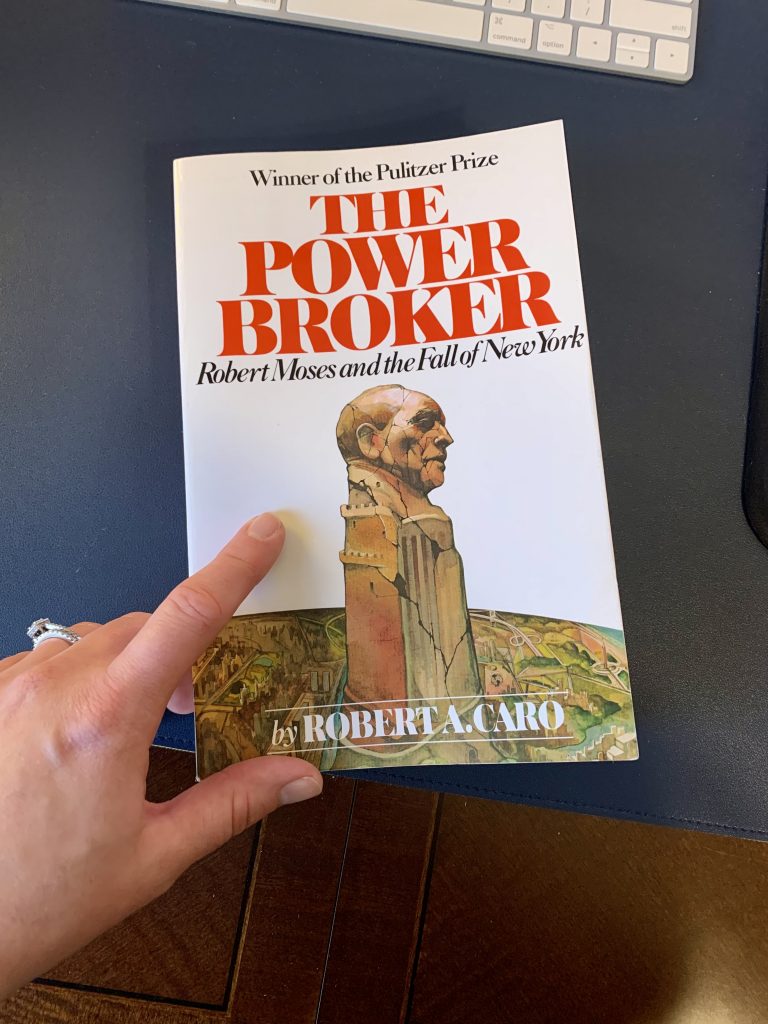
2. I’m currently reading the mammoth 1,162-page biography of Robert Moses, “America’s greatest builder”, who shaped most of New York City. I’m about halfway through and so far and it’s fascinating. It’s a jarring, behind-the-scenes look at how government works and how one man came to, and fell from, power.

3. Emotional intelligence doesn’t have to be complicated. It’s mostly a matter of ego.

4. The 100/0 Rule. At eighteen, Darren Hardy went to a seminar where the speaker asked the audience, “‘What percentage of shared responsibility do you have in making a relationship work?’” Audience members shouted out numbers like 50/50, and 51/49, and 80/20. The instructor turned around and wrote on the board: 100/0. “‘You have to be willing to give 100 percent with zero expectation of receiving anything in return’, he said. ‘Only when you’re willing to take 100 percent responsibility for making the relationship work will it work. Otherwise, a relationship left to chance will always be vulnerable to disaster.’”

5. Listen ten times more than you speak. Musonius Rufus said only a slave would be concerned about her voice being heard.

6. Be like a smelly goat. Marcus Aurelius said, “The straightforward and good person should be like a smelly goat— you know when they are in the room with you.” Live straightforwardly, he told himself. Let every utterance be truthful, so no one ever has to question your motives.

7. Contemplate the swings of fortune. Not talking or thinking about loss or death doesn’t mean it won’t happen. It just means it will be all the more distressing when it inevitably does.

8. Love isn’t about someone else. It’s a way of being.

9. Clear the mental and physical clutter. I taped this quote from Discipline is Destiny to my computer: “A person who doesn’t eliminate noise will miss the message from the muses.”

10. Notable books I read this month: The Boys in the Boat by Daniel James Brown, Shop Class as Soulcraft by Matthew B. Crawford

The quest for personal freedom

Last month I read Sarah Bakewell’s biography of sixteenth-century philosopher Michel de Montaigne and got so much out of it. Montaigne’s book Essays has influenced some of the greatest thinkers: from Francis Bacon and Jean-Jacques Rousseau to Friedrich Nietzsche and Shakespeare. Influential as he was, he was also, another biographer Stefan Zweig wrote, “the sworn enemy of all responsibility.” 

Montaigne’s “irresponsibility” was “essential to his battle to preserve his particular self as is.” Personal freedom is the supreme aim, he said, “to free oneself from fear and hope, belief and superstition. To be free of convictions and parties.” He thought certainty was absurd: all knowledge exists in humans, and because humans are fallible, all knowledge is to be doubted. He loved following his thoughts where they led, and delighted in viewing things from all possible angles. He went with the flow. If a book bored him or caused him to strain, he’d stop reading it, saying, “there is nothing I would break my head against in the name of scholarship.” He played with his cat, and pondered and wrote about his cat’s perspective. And he never worked harder than necessary. “The least strained and most natural ways of the soul,” he said, “are the most beautiful; the best occupations are the least forced.”

This idea of not straining yourself reminds me of how Richard Feynman won the Nobel Prize.

The Irresponsible Nobel Prize Winner

After spending 4 years working on the atomic bomb in Los Alamos, Richard Feynman accepted a position teaching physics at Cornell University. During this time, he was offered different positions at top universities with higher-paying salaries. Albert Einstein wrote him requesting he work at Princeton and the Institute for Advanced Study. Despite the wonderful offers, he couldn’t accept them—4 years of intense mathematical work in Los Alamos had left him drained. He was tired, uninterested in research, and couldn’t write more than 2 sentences on a scientific problem without becoming distracted. There was no way he could accept these offers, he reasoned, because they didn’t know he was burned out. “They expect me to accomplish something, and I can’t accomplish anything! I have no ideas…”

But then he had a thought. These offers, with their high expectations, were absurd. They would be impossible to live up to. And because they were impossible to live up to, he realized, he had no responsibility to live up to them. “It was a brilliant idea: You have no responsibility to live up to what other people think you ought to accomplish. I have no responsibility to be like they expect me to be.” He realized he could apply this idea to his current work at Cornell.

Then he had another thought. Physics was becoming less interesting to him, but he used to enjoy it. And he used to enjoy it because he played with it—unconcerned with its scientific importance. From now on, he would work only on physics problems that entertained him. “Now that I am burned out,” he thought, “and I’ll never accomplish anything . . . I’m going to play with physics, whenever I want to, without worrying about any importance whatsoever.”

Within a week, he was working on a “fun” project, causing a colleague to question its importance. “‘Hah!’ I say. ‘There’s no importance whatsoever. I’m just doing it for the fun of it.’ His reaction didn’t discourage me; I had made up my mind that I was going to enjoy physics and do whatever I liked.” This project that he worked on for fun ultimately led him to win the Nobel Prize.

The Wise Make Time to Play

Just as Marcus Aurelius wrote about not being “all about business,” Seneca advised his friend Lucilius that the mind will fracture if given too much work and that “it will rise improved and sharper after a good break.” Montaigne wrote, “There is nothing more notable in Socrates than that he found time when he was an old man to learn music and dancing, and thought it time well spent.”

Perhaps it was playfulness that gave Montaigne some of his philosophical insights. Summarizing Montaigne’s thoughts on world conflict, Bakewell writes, “To believe that life could demand [homicide in the name of religion] is to forget what day-to-day existence actually is. It entails forgetting that, when you look at a . . . . cat in the mood for play, you are looking at a creature who looks back at you. No abstract principles are involved; there are only two individuals, face to face, hoping for the best from one another.”

Scroll to Top