The ability to choose is the ultimate freedom

In early January of this year, my parents’ 16-year-old cat, Quinn, passed away. Her final week had been gut-wrenching.

The day after she passed, I called my dad and cried on the phone to him. (I felt guilty about this—I should have been the one comforting him and my mom, not the other way around—but I couldn’t help it.) I can’t stop thinking about Quinn’s final week, I told him, and I can’t stop crying. My dad listened patiently as always. When he finally spoke, he said something that instantly calmed me, and has calmed me since. “Em,” he said, “you can’t do this to yourself. We had sixteen great years with Quinn. So we can think about the 1 week of sadness or the 16 years of happiness, you know? We can choose.”

The 1 week of sadness or the 16 years of happiness. We can choose

Principles or People
If we bend the rules for one person, we’ll have to bend the rules for everyone. That was the position of Gavin de Becker’s client, a mid-sized city that was in a dispute with a former employee. The city had offered the ex-employee, who was retiring due to a mental disability, $11,000. The ex-employee refused to accept the offer because it didn’t include an extra $400 he felt entitled to. The city refused to pay the $400 because it was not approved beforehand and would therefore violate the rule. An ongoing dispute began, and the city hired Gavin de Becker to mediate. He advised them to pay the $400 (they’d already spent more than that fighting it) because it was an inconsequential sum and obviously a matter of pride. One day, the ex-employee showed up without notice and demanded to speak to the administrator who’d made the decision not to pay him. The two argued; neither side would budge. The ex-employee then laid two .38 caliber bullets on the admin’s desk and walked out. De Becker also learned that the ex-employee had recently shown his therapist a gun while talking about the situation. “Right is right, and right always wins,” he said. Still, the city refused to pay. It was a matter of principle—if they bent the rules for this employee, they’d have to bend them for everyone, they said. But, de Becker pointed out, that’s just not true. They wouldn’t need to make concessions for everyone—they’d just need to make them for the mentally unstable man who’d placed two bullets on the administrator’s desk and showed a gun to his therapist. “I don’t expect the city will be paying out on that policy too often,” de Becker said. By ignoring these red flags, the city was choosing principles over people. They were choosing pride over safety. Wisely, the city finally took de Becker’s advice and chose to pay the $400. As Oliver Wendell Holmes said, “The young man knows the rules, but the old man knows the exceptions.”

Special or Happy
A highly-respected financier, who’d made her fortune on Wall Street, was beginning to feel as though her work skills were declining. She was in her mid-fifties and younger colleagues were becoming leery of her decisions. She wasn’t as sharp as she once was. Panicked, she reached out to social scientist and author Arthur Brooks. He asked her about her life and learned she was unhappy, had been for years. She “lived to work” and was constantly exhausted from the long hours she put in. Her marriage was in decline. Her relationships with her adult children were strained. And now she was terrified that her career skills were deteriorating. To Brooks, the solution to her unhappiness seemed obvious. He asked her why she hadn’t taken the time to revive her marriage, or repair her relationships with her kids, or cut back on work hours. “I knew that her grueling work effort had made her successful in the first place,” he said, “but when you figure out something has secondary consequences that are making you miserable, you find a way to fix it, right? You might love bread, but if you become gluten intolerant, you stop eating it because it makes you sick.” She thought about his question for a few moments, then looked at him and said flatly, “Maybe I would prefer to be special rather than happy.” Brooks was stunned. For a long while after, he mulled over what she had said. It reminded him of something, but he couldn’t put his finger on what. Then it hit him. Her reasoning—that she preferred being special over being happy—was not unlike the response given by a recovering drug addict when asked why he had continued to get high even though he was fully aware it was making him miserable. “I cared more about being high than being happy,” he had told Brooks. The financier, Brooks realized, was an addict, too. A work addict. Maybe I would prefer being special rather than happy. She was miserable because she was choosing her ego over herself.

Choiceless or Free
Dr. Edith Eva Eger, whom I’ve written about, is a Holocaust survivor turned world-renowned psychologist. We already have the key to happiness in our pocket, she says. The key is knowing that, in every situation, we have a choice. Sent to Auschwitz at the age of sixteen, she writes candidly about the horrors of her imprisonment. “But even then,” she says, “in my prison, in hell, I could choose what I held in my mind. I could choose whether to walk into the electrified barbed wire, to refuse to leave my bed, or I could choose to struggle and live.” This is the same message in psychiatrist and Holocaust survivor Viktor Frankl’s classic book Man’s Search for Meaning. Rabbi and author Harold S. Kushner summarizes what he believes is Frankl’s most enduring message:

Forces beyond your control can take away everything you possess except one thing, your freedom to choose how you respond to the situation. You cannot control what happens to you in life, but you can always control what you will feel and do about what happens to you…Frankl would have argued that we are never left with nothing as long as we retain the freedom to choose how we will respond.

If the Stoics had to boil down their philosophy to just one idea, it would probably be the same as Eger’s and Frankl’s: we don’t control what happens, we only control how we respond to what happens. Our ability to choose our responses, the Stoics said, is what allows us to emulate the divine. No one has the power to take this ability from us. (“No thefts of free will reported!” Epictetus once joked.) And we can access it at any time, if we choose to.

P.S.
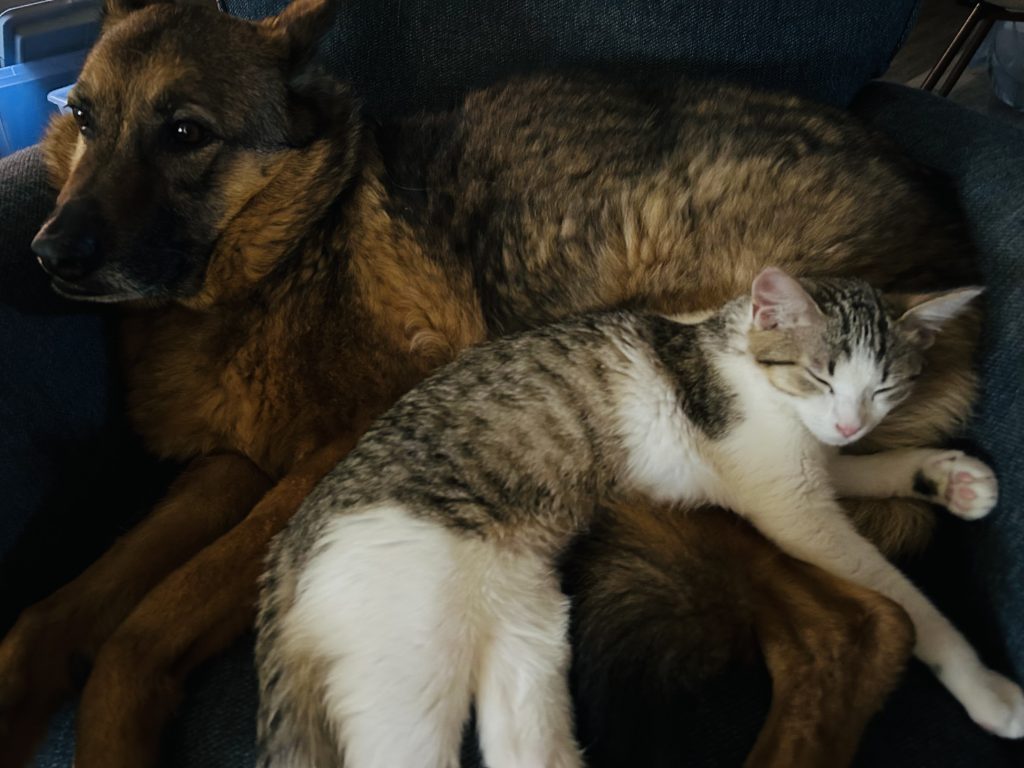
My parents have since adopted Piper, who’s now best friends with their dog, Minna.

Books Read This Month

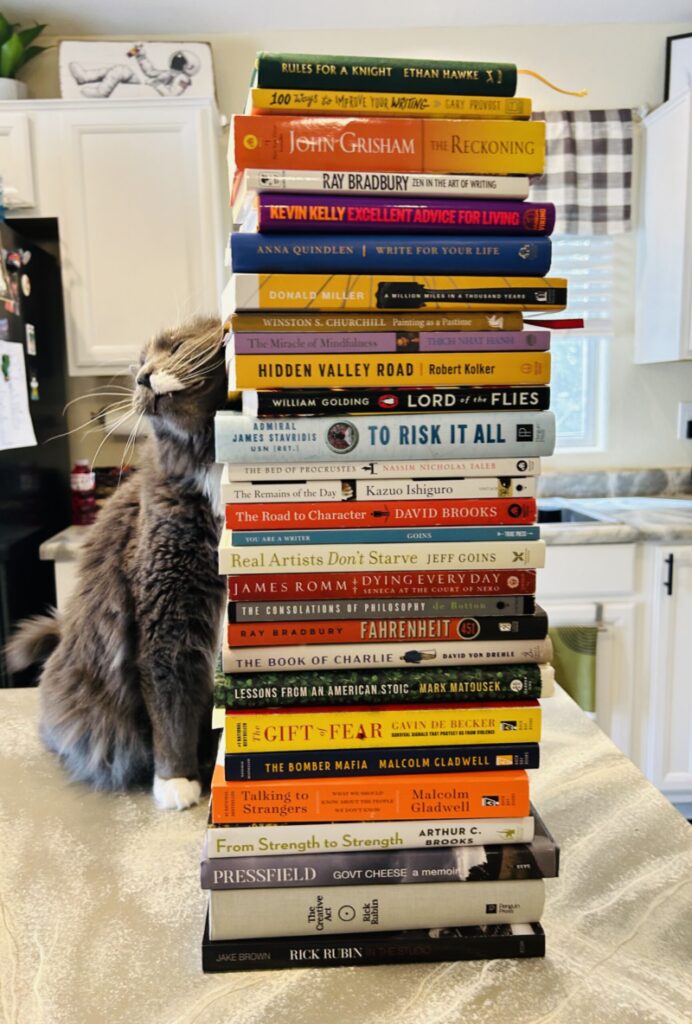
It’s been more than 10 years since I’ve read a Malcolm Gladwell book, and I forgot how much I enjoy his storytelling. One of the things I took from Talking To Strangers: What We Should Know about the People We Don’t Know is how bad we are at reading people and how the flimsiest evidence often skews our judgments. For instance, people who didn’t know Hitler personally knew him better than people who had spoken with him for hours. I also read his excellent book The Bomber Mafia which highlights the complexity of morality, especially in war. I read and loved Thich Nhat Hanh’s The Miracle of Mindfulness, and Winston Churchill’s Painting As a Pastime. Finally, I read Robert Kolker’s Hidden Valley Road, a nonfiction medical mystery about the Galvins, an all-American family with 12 children—2 girls and 10 boys. And 6 of the 10 boys were diagnosed with schizophrenia. Though sad, it’s also a beautiful story of love and family.Your Attractive Heading

Listening to who you are

A few years ago I read Steven Pressfield’s The War of Art, and I remember being just totally floored when he said, “Our job in this lifetime is not to shape ourselves into some ideal we imagine we ought to be, but to find out who we already are and become it.” We can’t just be whoever we want. We have to grow who we already are.

Less designing, more discovering. Less inventing, more listening. 

These 2 themes—becoming who you already are and listening—kept appearing in recent books I’ve read. In fact, these ideas have so inspired me that I’ve started doing my own form of meditative listening in our backyard.

You can’t really see it, but the dip in this rock is perfect for sitting. Every few evenings, I sit down, rest my arms on my knees, palms up, eyes closed, and listen. The first time I did this I was surprised by how much I heard: traffic in the distance, a dog barking, a car door shut, a trash can rumbling, the opening of the sliding glass door, my wife Courtney asking me what the hell I’m doing, the low hum of a plane, birds singing and hobbling around in the tangerine tree.

I breathed deeply. I smiled. Life was humming along, without me imposing, without me judging.

This exercise is part of my resolution this year to create more space in my life. To have fewer commitments, more time to explore and do nothing, more time with family, more time listening to the world around me, and, more importantly, to the world within me.

Formation, Not Transformation
Sports commentators like to talk about Andre Agassi’s personal transformation. At age 16 he turned pro and, without intending, became an image of rebellion. On the tennis court, he wore jean shorts, a headband tied at the back of his neck, a mullet hairpiece, and a dangle earring. Later in his career, with his wig long gone and his baldness embraced, he founded Agassi Prep, a charter school for at-risk children. When people say he transformed from punk to paragon, he cringes. He never thought of himself back then as a punk, any more than he thinks of himself now as a paragon. “Transformation is change from one thing to another,” he says, “but I started as nothing. I didn’t transform, I formed.” As a teenager, he rebelled for the same reason we all did: he didn’t know who he was. He was a work-in-progress, not a finished product. “What people see now, for better or worse, is my first formation, my first incarnation.” He didn’t become something new, he became more of what he already was. “I didn’t alter my image, I discovered it. I didn’t change my mind, I opened it.” 

The Songwriter Who’d Never Written a Song
At seven years old, long before founding the Grammy award-winning rock band Wilco, Jeff Tweedy would tell people he was a songwriter. Not that he was going to be one when he grew up, but that he already was one. “It turns out that the reason I started writing songs,” he says, “is because I happened to be a songwriter.” Never mind that he’d never written a song, he was a songwriter and that was a fact. As Robert Greene wrote in Mastery, “You have nothing to create. You merely dig and refine what has been buried inside of you all along.” Perhaps Tweedy intuited self-knowledge the way children do, the way they hear their hearts clearly, unmuffled by analysis. He knew he was a songwriter; he’d been one all along.

Permission to Listen
Security specialist Gavin de Becker helps to keep people safe. He does this, in large part, by giving people permission to listen to themselves, to their intuition. The great thing about our intuition is that it always has our best interests at heart. The problem is that we don’t always listen to it, and even when we do, we can be quick to dismiss it. Why is that? Take, for example, the myth that dogs have better intuition than humans. Our intuition is vastly superior to any animal because we’re vastly more knowledgeable. (Dogs simply respond to our intuition). It’s just that we have something that dogs don’t have: judgment. “With judgment comes the ability to disregard your own intuition unless you can explain it logically,” de Becker says in The Gift of Fear. (An awesome book by the way, especially for women). Relying on the intuition of a dog “is often a way to find permission to have an opinion we might otherwise be forced to call (God forbid) unsubstantiated.” In fact, it’s common for victims, while recalling the day of the crime, to “remember” something they weren’t consciously aware of at the time. ‘Now that I think about it, I spotted that same car earlier that day…’ De Becker isn’t saying, of course, to be suspicious and afraid of everything. (To do so would just be giving in to an overactive imagination.) But he is saying that when your gut is telling you something, listen. It can save your life.

Do This Every Day
Carl Jung said, “When an inner situation is not made conscious, it appears outside as fate.” In other words, when we don’t recognize our own agency, we’re at the mercy of circumstance. Our question becomes, Why me? instead of, What am I going to do about it? Having a sense of control over our lives is essential to our well-being. It allows us to take initiative and reassures us that regardless of what happens, we’ll adapt and be okay. One of the best ways I’ve found to develop agency is by journaling. Journaling makes the whispers of the heart audible. It forces you to pay attention to your life, to listen to it. If you don’t journal already, give it a shot. A quick 10 minutes each morning can have a profound impact on your life. (Trust me, it’s more important than any report, email, meeting, etc.) It might be the most important thing you do all day.

Books Read This Month

I finished The Creative Act: A Way of Being by Rick Rubin and I cannot recommend it enough. (I underlined or put a star next to something on almost every page.) My biggest takeaway is that art, like life, requires us to listen. To be still and to listen with our whole body. To surrender and open ourselves to what the universe is saying. I read Steven Pressfield’s memoir Govt Cheese, and loved it. He’s one of my favorite authors, and his work inspired the theme for this newsletter. I also read From Strength to Strength by Arthur C. Brooks, and so far it’s the best book I’ve read this year. It’s full of practical wisdom and I promise you’ll get something out of it that will improve your life.

Being isn’t as real as doing

Ralph Waldo Emerson said personal energy “resides in the moment of transition from the past to a new state.” It resides in the creative process. The finished product, he said, is dead in its completion. But the process of creating? That’s ripe with growth and opportunity.

There’s a word for something done solely for the end result: chore. This theme has come up again and again in recent books I’ve read, and I want to share two of my favorite takeaways.

How to Reduce Intrinsic Interest
There’s a classic psychology experiment involving children who liked to draw. They were given pens and paper and split into two groups. The children in the first group were given a reward for their drawings, which they were told about beforehand. The children in the second group received no rewards nor mention of them. After a few weeks, the children in the first group (those rewarded for their drawings) were less interested in drawing than those in the second group. The first group’s drawings were also judged to be of lower quality. The second group not only produced better work, but showed continued enjoyment in the activity. “The hypothesis,” says Matthew B. Crawford, “is that the child begins to attribute his interest, which previously needed no justification, to the external reward, and this has the effect of reducing his intrinsic interest in it.”

Being Isn’t as Real as Doing
In How to Write One Song, Jeff Tweedy says the question is not, Who do I want to be? It’s, What do I want to do? “Do you want to be a “star”? Don’t bother. You’re going to lose,” he says. “Even if you make it, you’ll lose. Because you’re never going to be exactly what you’re picturing.” Let’s say you want to be a rockstar. If by rockstar you mean you want to play music in front of people, you can do that. You can probably gradually play to larger groups of people too. You can experiment with new musical forms. You can dye your hair and create your own persona. Basically, you can do nearly everything “rockstars” do. Rockstar is a title. It’s not real. Doing something is real. Creating is real. You can be someone or you can do something.

Just That You Do the Right Thing
Stoicism is built around doing. Its goal is not to make you sound smart or help you debate abstract theories. It aims to solve problems in the real world. It doesn’t matter that you know Seneca’s letters by heart if you’re still worried about things you don’t control. 

Epictetus said don’t talk about your philosophy, embody it. “If your choices are beautiful, so too will you be.” And anything that is beautiful, said Marcus Aurelius, is beautiful by itself; beauty needs no title or recognition. “Does an emerald lose its quality if it is not praised?”

Doing the right thing—that’s what matters. That someone notices? Not your concern. That you’re given a reward because of it? Yawn. “Just that you do the right thing,” Marcus said, “the rest doesn’t matter. Cold or warm. Tired or well-rested. Despised or honored. Dying…or busy with other assignments. . . . There as well: ‘To do what needs doing’.”

(If you want to learn more about Stoic philosophy, these are the best books to start with: The Daily Stoic, Meditations, Letters From a Stoic, Discourses, Enchiridion, On the Shortness of Life.)

Books Read This Month

I needed a distraction this month, and John Grisham’s The Reckoning did the trick. Jake Brown’s Rick Rubin: In the Studio was a fascinating look at the why behind Rubin’s creative decisions, and how these decisions created and revolutionized multiple music genres. (I’m eager to read his new book The Creative Act: A Way of Being.) I’m also slowly making my way through Gary Provost’s 100 Ways to Improve Your Writing, which is short but rich. And I’ve just started reading The Gift of Fear by Gavin de Becker which I’m really enjoying so far. He uses real-life crime stories (which read like thrillers) to explain the psychology of human violence, and how to recognize the warning signs that can keep you safe.

The best books I read in 2022

It’s surprising how much you can read in a year when you read a little bit every day. I read ~50 books this year and I still feel like I could have been more disciplined about it. Good books have changed my life, and reading them helps me be a better person. Below are the best books I read this year. And I recommend you read them as well!

Buddha by Karen Armstrong

This is a wonderful, readable biography of the Buddha. We tend to think of enlightenment as the final destination. (What’s left to accomplish after reaching nirvana?) Maybe the Buddha believed this as well. But when he reached enlightenment, his sense of self disappeared. He saw at once the connectedness of all living things, and realized that “to live morally was to live for others.” It wasn’t enough that he reached nirvana—he had to help others reach it as well. He spent the next 45 years traversing the Ganges plain, spreading his dhamma to any and everyone he came across. His teachings survive today thanks to this “compassionate offensive”.

Discipline is Destiny by Ryan Holiday

No author has inspired or taught me more about life and philosophy than Ryan Holiday. This book on temperance (moderation) is the second in his four-part cardinal virtues series. He tells inspiring stories of people like Queen Elizabeth, Lou Gehrig, and Winston Churchill to illustrate the beauty of temperance, and contrasts it with cautionary stories of people like Alexander the Great and King George IV, who lacked temperance. I guarantee you’ll find something in this book that will enhance your life. Same with all of his books. This is one of my favorites of his, along with Ego is the Enemy, The Obstacle is the Way, and The Daily Stoic.

The Choice: Embrace the Possible by Dr. Edith Eva Eger

This book is just amazing. I gifted it to 2 friends and they couldn’t stop raving about it. Holocaust survivor Dr. Edith Eva Eger recounts the horrors of watching her parents be marched to the gas chamber, how she talked to herself through the unbearable realities of her imprisonment—“If I survive today,” she repeated to herself, “tomorrow I’ll be free.”—and how she ended up thriving in spite of it. Now a world-renowned psychologist, she gives her patients the advice that she learned long ago: the key to happiness and freedom is already within you. Life always gives you a choice. And as long as you have a choice, you’re free.

Four Thousand Weeks: Time Management for Mortals by Oliver Burkeman

The average human lifespan is about four thousand weeks. Because of this “insultingly short” period of time, Burkeman says we have to neglect almost everything to get anything done. Good time management, therefore, is basically knowing what to neglect. Burkeman gives us practical philosophy about the best ways to spend our time, and therefore, our life.

How to Write One Song by Jeff Tweedy

This is a fun little book on creativity that Amazon recommended. As the title implies, it’s mostly about songwriting, but I found a bunch of useful gems on creativity. Tweedy starts the book with a story of himself at 7 years old, telling people he’s a songwriter. Not that he was going to be one when he grew up, but that he already was one. Never mind he’d never written a song. This idea of becoming who you already are, as opposed to molding yourself into a vision you have, is something I plan on writing more about.

Other great reads this year: 

Why Buddhism is True by Robert Wright

Wanting: The Power of Mimetic Desire in Everyday Life by Luke Burgis

Open by Andre Agassi

How to be Content by Horace

The Art of Living: The Classical Manual on Virtue, Happiness, and Effectiveness by Sharon Lebell

How to Be Perfect by Michael Schur

That One Should Disdain Hardships by Musonius Rufus

Inner Engineering: A Yogi’s Guide to Joy by Sadhguru

Put Your Ass Where Your Heart Wants To Be by Steven Pressfield

Discourses by Epictetus

How to Live: Or a Life of Montaigne in One Question and Twenty Attempts at an Answer by Sarah Bakewell

The Art of Happiness by Epicurus

The Perfect Pass by S.C. Gwynne

The Boys in the Boat by Daniel James Brown

The Power Broker by Robert A. Caro

Wild Problems by Russ Roberts

Gift from the Sea by Anne Morrow Lindbergh

Letters from a Stoic by Seneca

Shop Class as Soulcraft by Matthew B. Crawford

And my all-time favorite books I read yearly:

The Daily Stoic by Ryan Holiday and Stephen Hanselman

A Calendar of Wisdom by Leo Tolstoy

Meditations by Marcus Aurelius

Scroll to Top