How to spend your time wisely

Seneca pointed out how far people will go to protect their money and property, but when it comes to their most valuable asset, time, they give it away for the flimsiest reasons.

Of all the ways we waste time, he said, the worst is through neglect. When we procrastinate. When we do nothing. When we do something other than what we should.

It’s this last part—doing something other than what we should—that Seneca said the whole of life is lost. It’s taking the job with better pay instead of the one that gives us space to learn. It’s staying in an unhealthy relationship. It’s making an elaborate Instagram story instead of logging a few miles on the treadmill. It’s checking the easy thing off our to-do list instead of struggling with the important thing for its own sake.

Maybe we do this because we’re afraid of failing or making mistakes. But if our aim is to spend our time well, then failing or making mistakes, or not having something tangible to show for our efforts, is irrelevant. Doing what we should be doing, regardless of the outcome—that’s time spent wisely.

Mistakes are Proof of Life
When Charlie White was 102 years old, writer David Von Drehle moved next door to him. The two men talked, and Drehle, inspired by the energetic centenarian, decided to write a book about Charlie’s life. Over the next few years, they would meet regularly and Charlie would share with Drehle stories from his life, including financial mistakes he’d made. Once, after the war, Charlie was asked if he’d like to invest in a ski resort in Aspen, Colorado, which was a ghost town at the time. He scoffed at the idea. This turned out to be a mistake. Another time, he sold the 60 acres of land he owned outside of Kansas City for far less than it would be worth when the land became a hotspot for multi-million dollar homes. Again, a mistake. He made another mistake when he later sold his small farm—right before the land was bought up and became some of the most desirable real estate in the country. Drehle commented to Charlie about all the fortune he had missed out on. ‘You don’t know the half of it,’ was Charlie’s cheerful response. He then recounted the time he was offered to invest in Marion Labs, a small start-up operating out of the owner’s basement. He declined, and the company went on to be worth billions. Another mistake. “Yet Charlie,” Drehle writes, “seemed to derive as much delight from recalling these blunders as he did from remembering [his] triumphs.” Not only was Charlie not bitter or resentful, he was ebullient. He understood there was virtue in making mistakes, that they weren’t disappointments. They were irrefutable proof that he was living his life to the fullest.

How To Make a Memorable Story
In Donald Miller’s beautiful memoir, A Million Miles in a Thousand Years, he talks about growing up in Odessa, Texas, where the high school football team had won the state championship. Twenty years later, he was surprised that a movie would be coming out about the Odessa team. A movie about a small-town football team from twenty years ago? Miller thought there must be a story he hadn’t heard, so he went to see it on opening night. Friday Night Lights was about overcoming odds and incredible conflict. Like all good sports movies, it came down to the last play in the championship game. And Odessa…lost? Miller was confused. Hadn’t Odessa won? After some quick research, he realized they hadwon—the following year. Friday Night Lights was not a story about them winning; it was about them almost winning. But why tell a story about almost winning? An article online said it was because the year Odessa lost, they had tried harder. The story about the year they won was good, but the story about the year they lost was better because they had sacrificed more. Miller took comfort in this idea and decided it was a good guide to life. “It was necessary to win for the story to be great,” he reflected. “It wasn’t only necessary to sacrifice everything.” 

Books Read This Month

-Reading The Pocket Epicurean by John Sellars made me calmer and happier. Sellars says Epicurus’s “vision of the ideal human life focused not on satisfying one’s physical appetites but rather on reaching a state free of all mental suffering.” Epicurus spent his life teaching people what happiness looks like and why we shouldn’t fear death. Seriously, read this book. (If you want a deeper dive into Epicureanism, check out The Art of Happiness.)

Candide by Voltaire. Wow. This book is…wild. And deep. And short enough to breeze through in a few hours. Candide travels the world and eventually comes to the conclusion that happiness is found in tending to one’s own garden, and in doing one’s own work. 

On Writing and Failure by Stephen Marche has a message for aspiring writers: Writing mostly means failing. To keep showing up is the whole point.

-I really enjoyed The Wager: A Tale of Shipwreck, Mutiny, and Murder by David Grann. The action and twists made it read like a thriller. But it also serves as a reminder that despicable things can look benevolent. And to not believe everything you hear.

Endurance by Alfred Lansing is an EPIC, true story of survival. (I audibly gasped a few times while reading.) What I found especially striking was the men’s optimism after their ship was crushed by ice. For instance, a year into their ordeal, while stranded on a merciless, arctic island with little hope of surviving, one of the crew’s surgeons, Alexander Macklin, wrote in his journal, “A horrible existence, but yet we are pretty happy…”

-My aunt sent me Think Like a Horse by Grant Golliher, and it is one of the best books on leadership I’ve ever read. Grant writes about the lessons he’s learned from his years of training horses. Lessons on building trust, paying attention, patience, and setting boundaries. Great examples too of how he’s used these lessons to be a better parent. Be soft yet firm. Or as Theodore Roosevelt said, “Speak softly and carry a big stick; you will go far.”

-Minus the misogynistic essays, I found tons of great stuff in Essays and Aphorisms by Arthur Schopenhauer. He was a pessimist who said the world is a miserable place, full of suffering. But he also said that if we lived in a Utopia, if everything was perfect, people wouldn’t know what to do with themselves. Instead of hanging themselves from boredom, they would go out and kill one another, thus creating an even worse world than this one. He said this is why the current world, in all its imperfections, is better than any other. I found a similar message in Candide—that people would rather cause themselves or others harm than be bored. Blaise Pascal summarizes this idea in one of my favorite quotes: “All of humanity’s problems stem from man’s inability to sit quietly in a room alone.”

What does money have to do with happiness?

It’s a tricky question.

Luckily for us, Epicurus, one of the wisest philosophers to have ever lived, thought a lot about it. And he had a lot to say.

To start, Epicurus defined happiness as not being in active pain, physically or psychologically.

To remedy physical pain, the answer is pretty straightforward. We need money for things like food, clothes, and shelter. 

To remedy psychological pain, however, the answer isn’t as clear-cut. Because of this, Epicurus spent more time addressing this pain. Anxiety, superstition, and fear are often self-inflicted. Meaning they’re mostly in our control.

The gist of his philosophy was this: as long as you’re not in pain, you have everything you need to be completely happy. Our emotional disturbances stem from how we see the world, which we can change at any moment. 

When it comes to money, Epicurus said, sure, it can make you happier, but only if you already have 3 things money can’t buy: friends, freedom from the need to impress others, and a reflective life.

Here’s a graph showing the correlation between money and happiness for a person without friends, freedom, and thought:

It’s important to note too that Epicurus said even with these 3 things and a lot of money, your level of happiness will never surpass what’s already available on a limited income.

Let’s examine these 3 things a little closer:

Friends
Take this thought experiment (paraphrased from Alain de Botton’s wonderful book The Consolations of Philosophy): Identify an idea for happiness. For example, In order to be happy on vacation, I need to stay at a luxury resort. Imagine that this idea might be false. Look for the exceptions between the supposed link to happiness and the desired object in the original statement. Could I spend money on a luxury resort and still not be happy? Could I be happy on vacation and not spend as much money on a resort? If an exception is found, the desired object (a luxury resort) cannot be a sufficient cause of happiness. It’s possible to have a miserable time at a luxury resort if, for example, I feel friendless and isolated. It’s possible to be happy in a tent if I am with someone I love and feel appreciated by. Now we can change the original statement to include these nuances. My happiness at a luxury resort will depend on being with someone I love and feel appreciated by. I can be happy without spending money on a luxury resort, as long as I am with someone I love and feel appreciated by. Our final statement for what would bring happiness is now different from the confused one we started with: Happiness depends more on having a congenial companion than staying at a fancy resort.

Freedom
“I wonder how many people would seek excessive wealth,” Nassim Nicholas Taleb mused, “if it did not carry a measure of status with it.” It makes you think. Finance writer and author of the amazing book The Psychology of Money, Morgan Housel said when it comes to money, everyone needs basics. Once those are covered, there’s the next level of comfortable basics. Past those are the basics that both comfort, entertain, and enlighten. “But spending beyond a pretty low level of materialism,” he says, “is mostly a reflection of ego approaching income, a way to spend money to show people that you have (or had) money.” He says if we want to increase our savings, we don’t need to raise our income, we need to raise our humility. A lack of humility won’t just hurt us financially, but emotionally as well. Without humility, life can become an endless chore of keeping our peacock feathers fully extended, trying to keep up with other people who are doing the same. It’s nothing new, though. Epicurus, born in 341 BC, saw this same human impulse. That’s why he warned against it. He saw how unhappy people became when they chained their identities to their finances. If our goal is to live happily, what sense does it make to get worked up over trivialities, such as vanity, since doing so would compromise our goal to live happily? If we never feel like we have enough, we will never be free. The great news is that freedom from this (and almost everything else) requires only a change in perspective. Your freedom is worth that much, right?

Thought
A person prone to worry will worry regardless of how much money she has. To the anxious mind, more money doesn’t solve problems, it just creates new ones. As Seneca put it, “One needs another happiness to safeguard the happiness one has; prayers need to be made on behalf of prayers already fulfilled.” He tells the story of a wealthy man he knew, Vedius Pollio, who went into such a rage when a slave dropped a tray of crystal glasses during a party, that Vedius ordered the slave to be thrown into a pool of vampire fish. “The possession of the greatest riches,” Epicurus said, “does not resolve the agitation of the soul nor give birth to remarkable joy.” Material things can’t unburden you. So what can? Modern psychology agrees with Epicurus: one of the best ways to combat worry is with thought. Specifically, rational analysis. It’s why journaling is one of the best (and most cost-effective) forms of therapy available. A reflective life is a good life. And a good life is a happy life. And a happy life, as we’ve seen, has little to do with money.

Alain de Botton beautifully summarized Epicurus’s point: “If we have money without friends, freedom, and an analyzed life, we will never be truly happy. And if we have them, but are missing the fortune, we will never be unhappy.”

Books Read This Month

-In 1959, four members of the Clutter family were brutally murdered in their home in Holcomb, Kansas. In In Cold Blood, reporter Truman Capote narrates this unsettling story while also diving into the lives and minds of the family’s ruthless, complex killers. I had a hard time putting this book down, so I wasn’t surprised to see that it’s ranked in Modern Library’s 100 Best Nonfiction Books of all time.

-In Feynman’s Rainbow, Leonard Mlodinow recounts his first year as a staff member in the Caltech physics department—and his interactions with the quirky, famous, brilliant physicist Richard Feynman. Mlodinow shares the advice Feynman had given him on science, creativity, careers, and life. There’s such great stuff in here. (I also loved Feynman’s autobiography, Surely, You’re Joking, Mr. Feynman.)

-A friend recommended Smoke Gets in Your Eyes: And Other Lessons from the Crematory by Caitlin Doughty and I LOVED it. This girl is hilarious. (I read a part to my wife while we were getting ready for bed and she prematurely spit out her Listerine.) Doughty says we, as a society, need more exposure to the topic of death, to be more comfortable talking about it, because it’s all around us and part of life. Reading this book has alleviated my superstitious phobia of the topic. And not to be intense but I feel liberated in a way. So much so that I’ve ordered 2 more books about death that I’ve heard great things about: Stiff by Mary Roach and All the Living and the Dead by Hayley Campbell.

-I had the book Tiny Beautiful Things by Cheryl Strayed on my bookshelf for years. While deciding what to read next, I picked it up to skim. Fifty pages later and I was kicking myself for not reading it years ago. No wonder this book has been recommended by so many people I admire! It’s basically an advice column in book form, and Strayed gives the WISEST advice. I asked my non-reader wife if I could read a chapter to her and she said sure (in the polite kind of way you say sure when someone asks you if you want to see pictures of their kids). But when I had finished reading the chapter, she asked me to read another. She even grabbed the book out of my hands a few times to take notes. Just a great book that I’ve learned so, so much from.

-I first read Ego is the Enemy by Ryan Holiday in 2016 and it completely changed my worldview. I read it again this month and was reminded why it’s one of the best books I’ve ever read. We waste so much of our lives chasing things we don’t care about, doing things we don’t want to do, trying to impress people we don’t respect. That’s ego. Ego cares about the title, not the job. It cares about posturing, not purpose. Ego wants it all. It wants a wife and a mistress. It demands recognition and praise. But ego is not real. It’s smoke and mirrors of the worst kind. And sadly, too many people learn this far, far too late.

How to Have a Life: An Ancient Guide to Using Our Time Wisely is a new translation of Seneca’s On The Shortness of Lifeone of my top 3 favorite books of all time (alongside Meditations and The Daily Stoic). It answers some of the deepest questions: What’s worth pursuing in life? How do we seize the time we have so it doesn’t flee past us? What things can we rightfully say no to? How do we stop arrogantly putting things off into the future, as if we’re sure we have endless days ahead of us? What I love about Seneca’s writing is how easy it is to read, how it feels like reading a letter from a friend, not some guy who lived 2,000 years ago. If you haven’t read this book already, you need to. You won’t regret it.

23 meditations that have helped me most (so far) in 2023

Whenever I read something I can’t stop thinking about or have an insight, I write it down.

Nothing crazy, just a sentence or two in a Google doc labeled “[Year] Insights”. It’s a way for me to remember what I’ve learned, so I can use what I’ve learned, and share it with others.

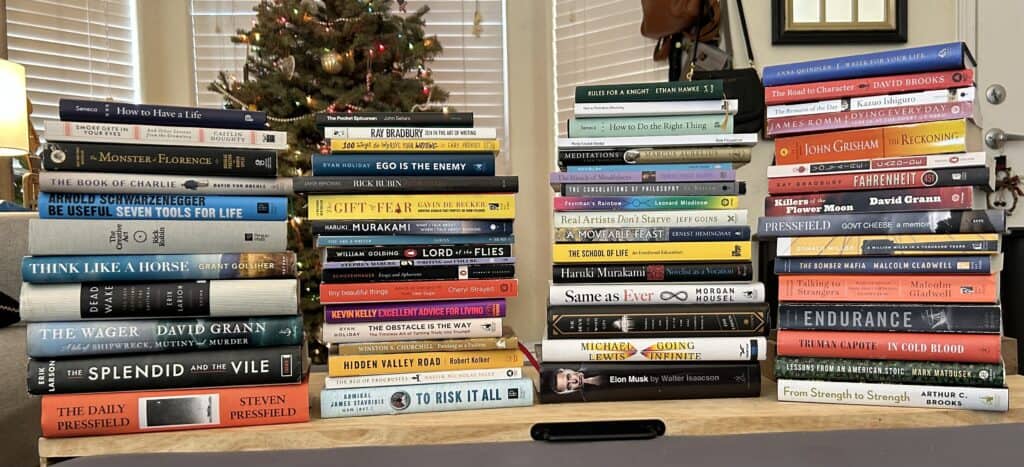
I had planned to narrow down the list and publish it in December, but it’s already grown considerably, in part due to the number of books I’ve managed to read so far this year:

So below are 23 meditations/ideas/insights I’ve been using in 2023:

1. The first rule for everything: don’t stress.

2. I’ve managed to more than double my reading this year by changing one thing: reading 2-3 books at a time instead of 1. If a book isn’t holding my attention, I’ll put it down and pick up a different one. Maybe I’ll come back to it in a week or a month when I’m in a different headspace. Maybe I won’t come back to it at all. The point is: I never want to let my lack of appetite for one book stop me from wolfing down another.

3. If you ask for feedback, you gain a critic. If you ask for advice, you gain a partner.

4. Kevin Kelly says that when you feel like stopping, give it 5 more minutes. What usually happens, he says, is that you hit your stride and end up exceeding the 5 minutes. I didn’t think much of this at first. But I gave it a try one day while running on my treadmill and it actually works.

5. Amelia Earhart said, “Move with your stick forward”. When I started this newsletter, I had no idea what I was doing. I still don’t. But life is short; you have to keep your foot on the gas and make adjustments as you go. If you wait until you have things figured out, you’ll never get anywhere. Move with your stick forward.

6. If what you’re doing isn’t worth your best, why are you doing it?

7. Pick up any good philosophy book and it probably talks about—indirectly or otherwise—the importance of living in a state of awe. Well, a cool thing I’ve learned is that you can be in awe of almost everything, not just sunsets and shooting stars. You can be in awe of how boring a speaker is. Or how long you’ve been on hold. You can be in awe of how many people sped up so you couldn’t merge. Or how long someone can talk about herself. In almost every situation, if you look for it, there is an opportunity for awe.

8. To meditate: focus on your breath. When you catch your attention wandering, bring it back to your breath. That’s all you need to know.

9. The religions and philosophies of the world aim to end suffering, not pain. Pain is part of life.

10. Sometimes I’ll catch myself procrastinating when it comes to doing something (relatively) easy. Actually, it’s because it’s easy that I feel like I can procrastinate: It’s just a half hour on the treadmill; it won’t make a difference if I skip today. I can make it up tomorrow. But when this reasoning pops into my head, I’ve been reminding myself of what Jim Rohn said: “What’s easy to do is just as easy not to do.” Then I hop on the treadmill.

11. When my parents’ cat, Quinn, passed away earlier this year, I was really sad. Her final week was gut-wrenching. But my dad reminded me that we can choose what we focus on. “We had sixteen great years with Quinn,” he said. “So we can think about the 1 week of sadness or the 16 years of happiness, you know? We can choose.” The 1 week of sadness or the 16 years of happiness. We can choose. Those words instantly calmed me, and they have calmed me since.

12. Creativity, like life, is about surrender, not force. It’s about listening. It’s about patience. “To listen impatiently,” Rick Rubin said, “is to hear nothing at all.”

13. A great way to waste your time: think about things that are not in your control.

14. Faith, by definition, cannot be argued. Even if it could be, we don’t know what we don’t know. We don’t even know if we have the capacity to know. I love how Montaigne put it: “We have formed a truth by the consultation and concurrence of our five senses, but perhaps we needed the agreement of eight or ten senses, and their contribution, to perceive it certainly and in its essence.”

15. Be suspicious of anyone who tries to turn you away from your faith. Don’t run from questions of faith—investigate them wholeheartedly. Even if it takes years or a lifetime, it’s a pursuit you will never regret. In fact, it’s probably one of the only pursuits you will never regret. The more you live in the spiritual world, and the less you live in the material one, the happier you will become.

16. Attention must be paid by the ounce. To work at peak capacity requires enormous effort. We can’t work at 100% all day. But we can work at 100% every day. That’s what professionals do—they show up every day and add another concentrated ounce to the bucket.

17. Breakthroughs are often hidden in hard work.

18. Don’t be a nerd. Nerds live inside boxes. Lunch is the same every day: a premade sandwich and a container of fruit. Work is statistical mathematics inside predictable software; variables are neatly accounted for. Their life is just as binary. The real world, with its complexity, shades of gray, nuance, chaos, and potential, is kept safely at bay. Fulfillment is traded for certainty. Don’t be a nerd.

19. Do things with a half-smile, especially chores. It makes a difference.

20. If you don’t know which book to read next, go with the one that sounds the most interesting.

21. To really experience life, don’t judge it. Just experience it. While listening to a song, don’t think about whether you like it, just listen. Experience it. You can always analyze it later, but experience it first.

22. Don’t be the best. Be the only.

23. It’s not how hard you work, it’s what you leave behind that counts.

Books Read This Month

Excellent Advice for Living by Kevin Kelly is one of the best books I’ve read this year. It’s wise and concise. (See the Quotes I’m Reflecting On section below.)

-Jeff Goins recommended Donald Miller’s memoir, A Million Miles in a Thousand Years, so I thought I’d give it a try. I’m really happy I did. It’s another one of the best books I’ve read this year. His writing is deep and funny (kind of like David Sedaris but a little more soul-searchy). Using the lessons he learned while producing a movie about his life, he shows how the elements used to create a good story are not much different from the elements used to create a good life. He encourages us to “live a better story.” (It reminded me of one of my other favorite books on life and writing, Anne Lamott’s Bird by Bird.) I enjoyed it so much that I ordered another book of his, Blue Like Jazz.

-I was in the mood for fiction so I picked up the award-winning book The Remains of the Day by Kazuo Ishiguro. I really, really enjoyed it. The overarching themes: What actually matters? What’s worth living for? What does it mean to live a good life?

The Book of Charlie: Wisdom from the Remarkable American Life of a 109-Year-Old Man by David Von Drehle is wonderful. What I loved most about Charlie was his absolute unwavering optimism. There was no misfortune he couldn’t find some good in. There was nothing he couldn’t use to his advantage. He shrugged off his mistakes—even big financial ones—as nothing more than the tax of life. To him, if you’re not making mistakes, you’re not really living, either. Or, as Harry Truman put it, “Imperfect action is better than perfect inaction.”

Write for Your Life by Anna Quindlen is a short, beautiful book on the importance of writing down your story.

Lessons From an American Stoic: How Emerson Can Change Your Life by Mark Matousek. Wow. Where do I start? This is also one of the best books I’ve read this year. I had kind of a revelation while reading about Emerson’s philosophy of Transcendentalism. “Transcendentalists sought a more direct relationship with God than was offered through stodgy church rituals,” writes Matousek. He describes Transcendentalism as a sort of spiritual rebellion against the hierarchical, sexist nature of certain churches. Transcendentalism “teaches that spiritual intermediaries are unnecessary for maintaining a close connection with God.” Wow. I finally have a name for something I’ve long felt but could not put into words, and I’m eager to learn more about it. I’m so grateful to have found and read this book.

If we can’t be present now, we can’t be present later

This month, Courtney and I drove from Phoenix to San Diego for a bridal shower and mini vacation. The drive is ~5 hours and relatively easy, minus the winding mountain roads during the final stretch (at which point you can just let your California native wife take over, and close your eyes as she whips the car around 90-degree turns, at elevations of 4,000 feet, believing any consideration of physics and its laws to be an excuse used by slow, bad drivers).

As usual on road trips, I was counting down the minutes until our arrival, excited about everything we would do. But as I sat behind the wheel, cruise control on, an open road ahead, listening to one of my favorite books with my wife, I wondered why I was in such a hurry to get there.

It’s something I never thought much about, it’s just what you do—get there as fast as possible. When you’re a kid you whine, are we there yet? When you’re an adult you already know you’re not there yet and you won’t be there for another 256 miles. Traveling is the inconvenient part of vacationing, the part you muscle through to get to where you want to be. 

But as Interstate 8 stretched on, I thought about what a great time I was having. Why am I rushing through a beautiful drive with my best friend? So I can get to the hotel sooner? So we can check in and head to the beach? So we can sit and enjoy each other’s company and do essentially the same thing we are already doing?

I realized I was already having the time of my life! What I wanted wasn’t over there, it was right here, just waiting for me to notice.

It struck me how absurd it was to think I could be present at the beach when I couldn’t even be present in the car. It reminded me…

If We Can’t Live In This Moment, We Can’t Live In Any Moment
When Thich Nhat Hanh would have friends over for dinner, he had a routine of washing the dishes afterward before sitting down to drink tea with everyone. One evening, his friend Jim Forest asked if he may wash the dishes. Go ahead, Thich replied, just remember there are 2 ways to wash the dishes: “The first is to wash the dishes in order to have clean dishes and the second is to wash the dishes in order to wash the dishes.” If we’re washing the dishes to get to the tea, we aren’t really washing the dishes. The rest of Thich Nhat Hanh’s assertion is worth quoting in full:

“What’s more, we are not alive during the time we are washing the dishes. In fact, we are completely incapable of realizing the miracle of life while standing at the sink. If we can’t wash the dishes, then chances are we won’t be able to drink our tea either. While drinking the cup of tea, we will only be thinking of other things, barely aware of the cup in our hands. Thus we are sucked away into the future—and we are incapable of actually living one minute of life.”

You’re Exactly Where You’re Supposed to Be. Enjoy It
In Ethan Hawke’s beautiful book Rules for a Knight the protagonist, Sir Thomas Lemuel Hawke, recounts a time in his childhood when he went to see his grandfather to ask him for advice about how to live his life. His grandfather welcomed him warmly, happy to share his wisdom. The boy congratulated himself for coming, saying, “I knew I’d come to the right place.” His grandfather looked at him and said, “I’m glad you’ve come, Thomas. I’ve been hoping you’d show your face at my door for a long time, and I will happily accept you as my squire, if that’s what you want. But the first thing you must understand is that you need not have gone anywhere. You are always in the right place at exactly the right time, and you always have been.” He then paused and asked the boy, “Do you know why King Arthur’s knights could not see the mountain peak of Sea Fell?” Thomas said he did not. “Because,” his grandfather smiled, “that’s where they were standing.”

Books Read This Month

The Consolations of Philosophy by Alain De Botton is amazing. Each chapter comprises 2 things: a common, specific problem and a posthumous philosopher with the best solutions for it. From how Socrates dealt with unpopularity (and why it’s sometimes a good thing to be unpopular), to how Montaigne overcame his perceived inadequacies, it gives an abundance of excellent advice. It’s one of the best books I’ve read this year. I read You Are a Writer (So Start Acting Like One) and Real Artists Don’t Starve by Jeff Goins. I added both to my list of favorite books on writing and creativity, and both helped me understand that as much as art needs business, business needs art, and to not sell yourself short. I read Lord of the Flies by William Golding for the first time which was, of course, great. We listened to one of my favorite books, The Obstacle is the Way, by Ryan Holiday on our road trip. I read Ethan Hawke’s wonderful, philosophical gem Rules for a Knight and I loved it. I also read James Romm’s Dying Every Day, an awesome biography of Seneca during his time as an advisor to the unhinged Nero. It’s a great mix of drama, history, and philosophy.

What we don’t know

A man arrives at work one day and instead of walking through the main entrance, he goes around back. As another person enters through the back door, the man rushes to catch it before it can close and lock. Once inside, his coworker says to him, “The boss wants to see you.” Without looking up, the man mutters a barely audible, “Yeah, I want to see him too.” In the locker room, he sets down his gym bag—a bag far too large for just clothing—and pulls out a pistol and a handgun. He conceals both under his coat. Then, he goes to look for his boss.

Based on what you know so far, context would assist you if you had to predict what this man would do next. But, as Gavin de Becker points out in The Gift of Fear, (a super fun and engaging read, by the way!) just one small piece of information changes the context of this story: the man is a police officer. Your prediction would likely be different if he was a postal worker. 

The greatest enemy of perception—and therefore, accurate predictions—he says, is judgment. 

And it’s so easy to judge what we think we know. But a theme that keeps coming up in my reading is that we don’t know much of, well, anything.

What if we were more honest with ourselves and others about what we don’t know? If wisdom begins in humility, then it’s more than okay that we don’t know. In fact, it’s the best place to start…

Compassionate Assumption
People can frustrate us. And sometimes when they do, we make harmful judgments about them (the worst of those judgments being that they did something to us). My daughter is purposely trying to make my life miserable. The guy who cut me off is a jerk. My spouse is incapable of understanding why I’m upset. But what if, as Ryan Holiday said in last week’s Daily Stoic email, we fought to defend their side instead of attack it? What if, instead of working to produce evidence against someone, we worked to produce evidence for them? We could follow Seneca’s advice and play the role of public defender, and “plead the case of the absent defendant despite our own interests.” Maybe my daughter is acting out as a way of asking for help. Maybe that guy is having a bad day. Maybe I’m not communicating with enough love toward my spouse. Because we don’t ever really know what someone is going through, do we? Even the people closest to us struggle with things we’ll never know about, let alone comprehend. In any case, we can default to compassionate assumption. If nothing else, it will make us calmer and happier.

What If Five Senses Aren’t Enough?
The sixteenth-century writer and philosopher Montaigne was famous for his skepticism of knowledge. He worked for the court of inquiry and, when a civil case was too complex for a quick verdict by the judge, was tasked with summarizing the evidence for both sides, without passing judgment. Dubbed the king of uncertainty, he knew all evidence was error-prone, and therefore so were decisions based on it. Judges and lawyers were fallible too, and to be doubted. Even the laws themselves were to be questioned because they were made by humans. Perhaps it was this court work that made him skeptical of things, himself included. He vigorously investigated the nuanced, opposing impulses of his soul, but he never took himself too seriously. (He would laugh at his own contradictions and silliness.) Much of his writings end with phrases such as “though I don’t know,” which, Sarah Bakewell writes in How To Live, is pure Montaigne. Basically, he believed that all knowledge should be doubted because it resides in human beings. “We have formed a truth by the consultation and concurrence of our five senses,” he said, “but perhaps we needed the agreement of eight or ten senses, and their contribution, to perceive it certainly and in its essence.” 

Doubt As a Case For Faith
The philosopher Descartes said, “Everything I perceive clearly and distinctly cannot fail to be true.” But, as Montaigne would have pointed out, we can’t possibly know whether we are capable of seeing things clearly, let alone be sure that we do. I think about this a lot when it comes to religious faith. In David Brook’s wonderful book The Second Mountain, he points out that even the most religious people have regular doubts about their faith. Mother Theresa did. Brooks says he still does. But, he argues, faith is strengthened, not destroyed, by doubts. Montaigne likely would have agreed, as Sarah Bakewell writes that he “denied that humans could attain knowledge of religious truths except through faith. Montaigne may not have felt a great desire for faith, but he did feel a strong aversion to all human pretension—and the result was the same.”

Books Read This Month

I read The Road to Character by David Brooks and it was amazing. He tells the stories of people like Dorothy Day, George C. Marshall, A. Phillip Randolph, and Augustine, and the ongoing inner battles they fought to live a life of meaning and purpose. Reading their stories helped me to better understand what it means to live life to its fullest. I can’t recommend this book enough. I read and enjoyed Admiral James Stavridis’s To Risk It All: Nine Conflicts and the Crucible of Decision. He combines his 30-plus years of experience in the US Navy with 9 crucial moments in the Navy’s history, to help answer this question: How do great decision-makers make their decisions? And because it’s a collection of 9 different stories, the pages flew by. I also read a hidden gem I found in a used bookstore: an old copy of Ray Bradbury’s Zen in the Art of Writing, which I loved so much that I bought and read Fahrenheit 451 which was so good that I added it to my list of favorite books. (I’m sad to say it was my first reading of Fahrenheit; I was book-averse when it was assigned in high school.) I was surprised that it touched on so many of my favorite themes: slowing down, being still, dancing in the rain and taking walks and being present and doing things for no reason other than to do them. Just a great book. Finally, I read The Bed of Procrustes: Philosophical and Practical Aphorisms by Nassim Nicholas Taleb, and oh my gosh, I had so much fun reading it; I wrote exclamation marks on nearly every other page. It’s a book about what we don’t know and how we handle what we don’t know. And I found a lot of cool ideas to potentially use in my own writing.

Scroll to Top