Listening to who you are
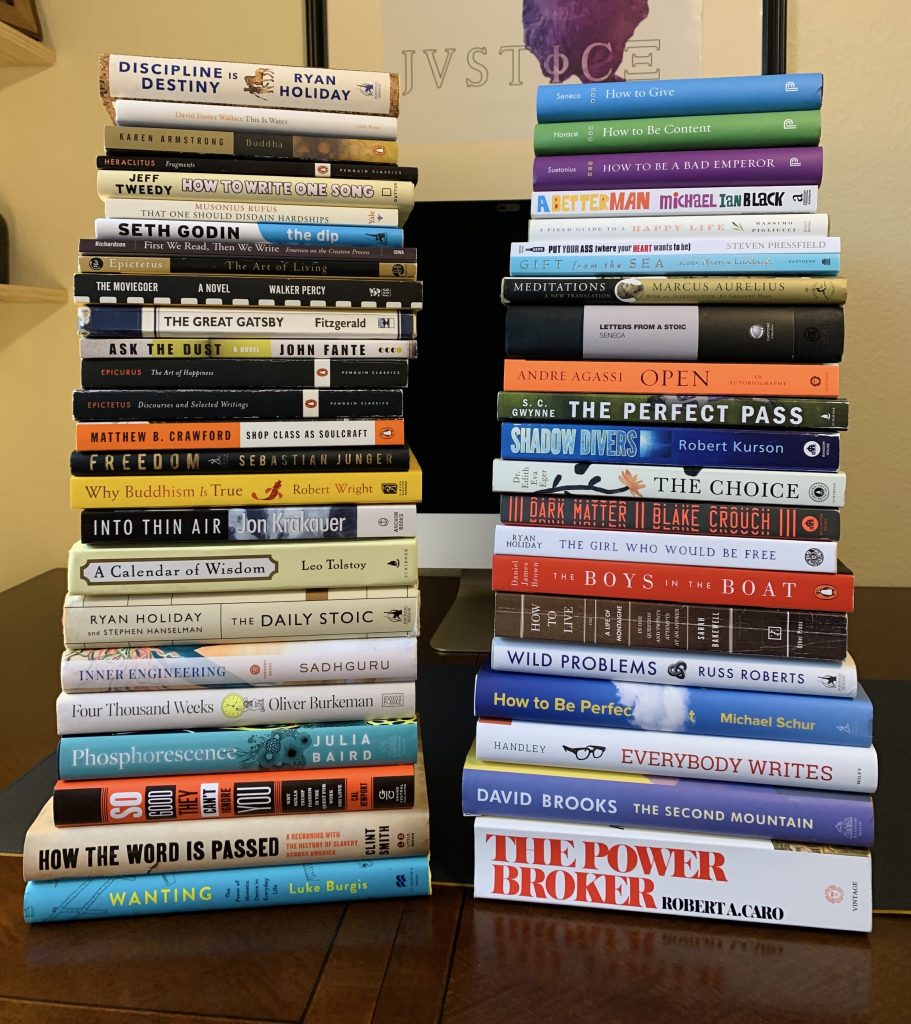
A few years ago I read Steven Pressfield’s The War of Art, and I remember being just totally floored when he said, “Our job in this lifetime is not to shape ourselves into some ideal we imagine we ought to be, but to find out who we already are and become it.” We can’t just be whoever we want. We have to grow who we already are.
Less designing, more discovering. Less inventing, more listening.
These 2 themes—becoming who you already are and listening—kept appearing in recent books I’ve read. In fact, these ideas have so inspired me that I’ve started doing my own form of meditative listening in our backyard.

You can’t really see it, but the dip in this rock is perfect for sitting. Every few evenings, I sit down, rest my arms on my knees, palms up, eyes closed, and listen. The first time I did this I was surprised by how much I heard: traffic in the distance, a dog barking, a car door shut, a trash can rumbling, the opening of the sliding glass door, my wife Courtney asking me what the hell I’m doing, the low hum of a plane, birds singing and hobbling around in the tangerine tree.
I breathed deeply. I smiled. Life was humming along, without me imposing, without me judging.
This exercise is part of my resolution this year to create more space in my life. To have fewer commitments, more time to explore and do nothing, more time with family, more time listening to the world around me, and, more importantly, to the world within me.
Formation, Not Transformation
Sports commentators like to talk about Andre Agassi’s personal transformation. At age 16 he turned pro and, without intending, became an image of rebellion. On the tennis court, he wore jean shorts, a headband tied at the back of his neck, a mullet hairpiece, and a dangle earring. Later in his career, with his wig long gone and his baldness embraced, he founded Agassi Prep, a charter school for at-risk children. When people say he transformed from punk to paragon, he cringes. He never thought of himself back then as a punk, any more than he thinks of himself now as a paragon. “Transformation is change from one thing to another,” he says, “but I started as nothing. I didn’t transform, I formed.” As a teenager, he rebelled for the same reason we all did: he didn’t know who he was. He was a work-in-progress, not a finished product. “What people see now, for better or worse, is my first formation, my first incarnation.” He didn’t become something new, he became more of what he already was. “I didn’t alter my image, I discovered it. I didn’t change my mind, I opened it.”
The Songwriter Who’d Never Written a Song
At seven years old, long before founding the Grammy award-winning rock band Wilco, Jeff Tweedy would tell people he was a songwriter. Not that he was going to be one when he grew up, but that he already was one. “It turns out that the reason I started writing songs,” he says, “is because I happened to be a songwriter.” Never mind that he’d never written a song, he was a songwriter and that was a fact. As Robert Greene wrote in Mastery, “You have nothing to create. You merely dig and refine what has been buried inside of you all along.” Perhaps Tweedy intuited self-knowledge the way children do, the way they hear their hearts clearly, unmuffled by analysis. He knew he was a songwriter; he’d been one all along.
Permission to Listen
Security specialist Gavin de Becker helps to keep people safe. He does this, in large part, by giving people permission to listen to themselves, to their intuition. The great thing about our intuition is that it always has our best interests at heart. The problem is that we don’t always listen to it, and even when we do, we can be quick to dismiss it. Why is that? Take, for example, the myth that dogs have better intuition than humans. Our intuition is vastly superior to any animal because we’re vastly more knowledgeable. (Dogs simply respond to our intuition). It’s just that we have something that dogs don’t have: judgment. “With judgment comes the ability to disregard your own intuition unless you can explain it logically,” de Becker says in The Gift of Fear. (An awesome book by the way, especially for women). Relying on the intuition of a dog “is often a way to find permission to have an opinion we might otherwise be forced to call (God forbid) unsubstantiated.” In fact, it’s common for victims, while recalling the day of the crime, to “remember” something they weren’t consciously aware of at the time. ‘Now that I think about it, I spotted that same car earlier that day…’ De Becker isn’t saying, of course, to be suspicious and afraid of everything. (To do so would just be giving in to an overactive imagination.) But he is saying that when your gut is telling you something, listen. It can save your life.
Do This Every Day
Carl Jung said, “When an inner situation is not made conscious, it appears outside as fate.” In other words, when we don’t recognize our own agency, we’re at the mercy of circumstance. Our question becomes, Why me? instead of, What am I going to do about it? Having a sense of control over our lives is essential to our well-being. It allows us to take initiative and reassures us that regardless of what happens, we’ll adapt and be okay. One of the best ways I’ve found to develop agency is by journaling. Journaling makes the whispers of the heart audible. It forces you to pay attention to your life, to listen to it. If you don’t journal already, give it a shot. A quick 10 minutes each morning can have a profound impact on your life. (Trust me, it’s more important than any report, email, meeting, etc.) It might be the most important thing you do all day.
Books Read This Month
I finished The Creative Act: A Way of Being by Rick Rubin and I cannot recommend it enough. (I underlined or put a star next to something on almost every page.) My biggest takeaway is that art, like life, requires us to listen. To be still and to listen with our whole body. To surrender and open ourselves to what the universe is saying. I read Steven Pressfield’s memoir Govt Cheese, and loved it. He’s one of my favorite authors, and his work inspired the theme for this newsletter. I also read From Strength to Strength by Arthur C. Brooks, and so far it’s the best book I’ve read this year. It’s full of practical wisdom and I promise you’ll get something out of it that will improve your life.